ISO 27001 certified & SOC 2 Type II attested · Works to comply with GDPR, CCPA & CASL
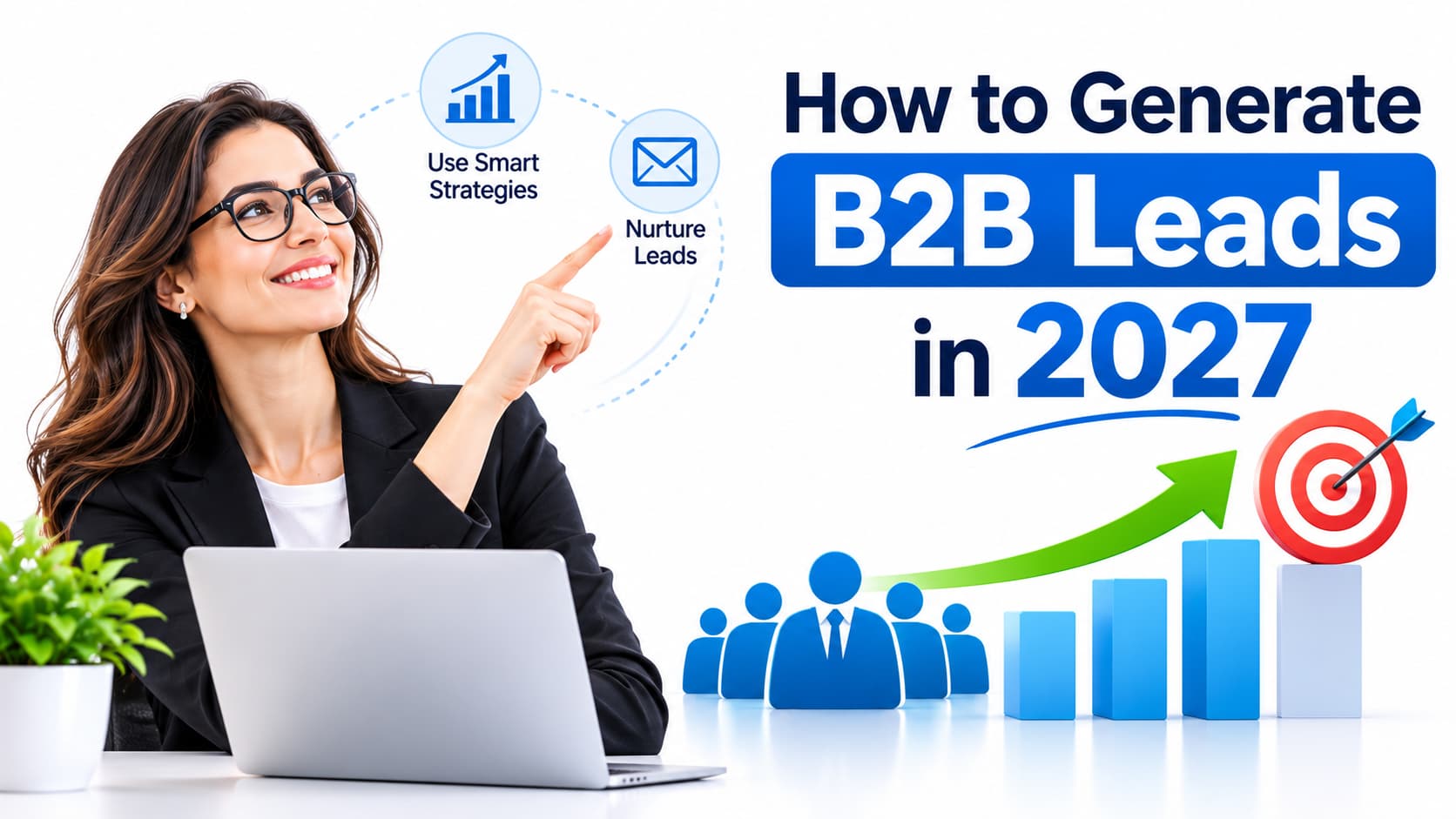
Quick answer: To generate B2B leads, define your ideal customer profile (ICP), build a segmented list of companies and decision-makers that match it, and reach them through a mix of SEO, LinkedIn, personalized email, account-based marketing (ABM), webinars and referrals. Use accurate business contact data, personalize your messaging, track every lead in a CRM and judge each channel by the qualified opportunities it produces, not by raw lead volume.
Generating B2B leads is not about collecting email addresses or sending hundreds of sales messages. It is about finding businesses that need your solution, identifying the people who influence the purchase, reaching them through relevant channels and turning their interest into sales conversations.
In 2027, the teams that do this well combine inbound marketing, targeted outbound prospecting, account-based marketing, professional networking, quality business data and personalized communication. Whether you run a startup, a SaaS company, a marketing agency, a consulting firm or an enterprise sales team, a structured approach helps you reach the right buyers more efficiently.
This guide explains 12 practical strategies, how to put each one into practice, which tools can support you and how to measure results. If you are new to the topic, start with our beginner’s guide to B2B lead generation for the fundamentals.
The 12 strategies below map onto these steps. Strategies 1 and 2 cover the foundation, strategies 3 to 9 cover channels, and strategies 10 to 12 cover data, conversion and follow-up.
B2B (business-to-business) lead generation is the process of identifying, attracting and engaging potential business customers who may want to buy your products or services.
Unlike B2C lead generation, which targets individual consumers, B2B lead generation focuses on organizations and the people inside them: executives, department heads and other purchasing decision-makers. A company selling cybersecurity software, for example, might target:
The goal is to connect with the people who influence or make purchasing decisions at relevant organizations. Businesses do this through several channels, including:
An effective program combines several of these channels instead of depending on a single source.
B2B purchases involve multiple stakeholders, research, comparisons and internal approvals, so reaching the right people at the right stage of the buying journey matters. A well-planned strategy helps you:
Measure success by qualified opportunities and revenue contribution, not by the number of contacts collected.
The right strategy depends on your industry, sales cycle, audience, budget and goals. Most teams combine several of the approaches below. Here is how they compare at a glance:
| # | Strategy | Approach | Best suited for |
|---|---|---|---|
| 1 | Define your ideal customer profile | Foundation | Every B2B team |
| 2 | Build a targeted prospect list | Outbound | Teams ready to prospect directly |
| 3 | LinkedIn prospecting | Outbound and inbound | Relationship-led and higher-value sales |
| 4 | SEO and content marketing | Inbound | Long-term, compounding demand |
| 5 | Personalized email outreach | Outbound | Reaching defined segments directly |
| 6 | Account-based marketing | Outbound and inbound | High-value accounts and long sales cycles |
| 7 | Webinars and virtual events | Inbound | Educating buyers with complex needs |
| 8 | Paid advertising | Paid inbound | Capturing high-intent searches |
| 9 | Referrals and partnerships | Relationship | Trust-led introductions |
| 10 | Sales intelligence and enrichment | Foundation | Research and complete CRM records |
| 11 | Lead magnets and landing pages | Inbound | Turning visitors into prospects |
| 12 | Lead nurturing and CRM automation | Follow-up | Prospects who are not ready to buy yet |
Before you invest in lead generation, decide exactly which businesses you want to reach. An ideal customer profile describes the type of organization most likely to benefit from your product or service.
Without one, marketing teams generate large numbers of irrelevant leads and sales reps spend time on companies that are unlikely to convert. Start with your existing customers: look for the industries, company sizes, locations and traits shared by your most successful accounts.
What should your ICP include?
| ICP attribute | What to identify |
|---|---|
| Industry | Healthcare, technology, finance, manufacturing, real estate |
| Company size | Startup, SMB, mid-market, enterprise |
| Annual revenue | Your target revenue range |
| Geography | Country, state, city or region |
| Job function | Sales, marketing, IT, finance, operations |
| Seniority | Manager, director, VP, C-suite |
| Technology | Software and platforms the company uses |
| Business challenges | Problems your solution addresses |
Many of these attributes can be turned into list filters later. See how data providers segment by company size and revenue, by SIC and NAICS code and by technology used.
Example ICP. A B2B marketing automation company might define its target like this:
A definition like this gives marketing and sales a much clearer direction.
Actionable tip: Create a separate ICP for each customer segment if you serve more than one industry. A healthcare technology company and a manufacturing supplier usually have different buyers, challenges and purchasing processes.
Once you know who you want to reach, identify the companies and contacts that fit. A targeted prospect list gives you structured information about potential customers, including professional contact details and company characteristics. Build it around your ICP instead of collecting random business email addresses. Our guide to building a B2B prospect list that converts goes deeper on the process.
Step 1: Select your target industries. Pick the industries where your solution delivers the most value, such as healthcare, information technology, financial services, manufacturing, real estate, education, retail or professional services.
Step 2: Identify relevant job titles. Work out who evaluates, recommends, approves or buys. A company selling enterprise IT solutions might target CIOs, CTOs, IT decision-makers, infrastructure managers and procurement directors. For more on mapping buyers, see how to reach B2B decision-makers.
Step 3: Apply company filters. Refine by company size, revenue, location, business type and other relevant traits.
Step 4: Collect the contact fields you need. Depending on how you source data, useful fields include first and last name, business email address, job title, department, company name and website, industry, company size, revenue range, phone number and location.
Step 5: Verify and organize. Check contact details, remove duplicates, review outdated records and segment the final audience.
From a broad audience to a targeted list:
| Broad targeting | Refined targeting |
|---|---|
| Technology companies | B2B SaaS companies |
| All employees | Marketing decision-makers |
| United States | New York and California |
| Any company size | 50 to 500 employees |
| All job titles | CMO, VP Marketing, Marketing Director |
The refined audience is a far better foundation for personalized outreach.
How CampaignLake supports targeted prospecting. CampaignLake provides B2B contact and company data that sales and marketing teams can use to build audiences like the one above. Its database covers 500M+ B2B contact profiles across 180+ countries and 100+ industries, with 40+ data fields and filters including industry, job title, seniority, company size, revenue, location and technology use. Browse the available categories in CampaignLake’s B2B email list, or read how records are sourced and checked on the data sourcing page.
If you plan to buy data, a written brief gets you an accurate count faster. Our guide to briefing a B2B data provider lists the filters and exclusions to specify.
Actionable tip: Start with a small, clearly defined audience. Check the relevance and quality of the records before you expand your prospecting.
Access CampaignLake's Industry-Specific Email Database
LinkedIn is one of the most relevant professional networks for identifying prospects, researching companies and building relationships with decision-makers. You can find people by job title, employer, industry and experience. Successful prospecting takes more than sending connection requests, though.
Optimize your company profile. Your page should make clear what you offer, which industries you serve, what problems you solve, who benefits and how to contact you.
Research prospects with advanced filters. LinkedIn Sales Navigator supports filtering by current company, job title, seniority, industry, company headcount, geography and recent job changes.
Publish useful industry content. Share content that addresses your audience’s challenges: industry reports, educational guides, customer success stories, practical tips, market insights and product demonstrations.
Build relationships before pitching. Engage with relevant posts, join industry discussions and share useful insights before you start a sales conversation.
Example connection message:
“Hi Sarah, I noticed your team is expanding its B2B marketing operations. We work with businesses looking to improve prospect targeting and pipeline development. I’d be glad to connect and exchange ideas.”
Keep the message relevant, short and focused on starting a conversation.
Actionable tip: Build separate prospect lists for each industry and job function. One generic LinkedIn message rarely speaks to every buyer’s priorities.
SEO is a long-term strategy that attracts prospects who are already researching solutions to their problems. When potential customers search for topics related to your offer, helpful content puts your business into their research process. A CRM vendor, for example, could target searches such as how to improve sales pipeline management, CRM best practices for small businesses or sales automation strategies.
How to generate B2B leads through SEO:
Content formats that work for B2B:
| Content format | Example topic |
|---|---|
| Educational blog | How to generate B2B leads |
| Industry guide | B2B marketing strategies for healthcare companies |
| Comparison article | CRM vs. marketing automation |
| Research report | State of B2B sales prospecting |
| Case study | How a business improved its sales pipeline |
| Checklist | B2B lead qualification checklist |
| Resource page | Essential tools for B2B marketing teams |
Make your content useful for AI search. Buyers increasingly use AI-assisted tools to research vendors, so write content that is easy to understand, extract and verify:
No one can guarantee an AI Overview or an AI citation. The aim is genuinely useful, trustworthy content that search systems can interpret. For how Google’s AI features relate to your site, see its documentation on AI features and your website.
Actionable tip: Do not publish articles just to grow your blog count. Build content around real customer questions and link each article to a relevant commercial page.
Email remains an important B2B prospecting channel because it lets you reach relevant professionals directly. Sending the same message to thousands of unrelated contacts rarely works. A better approach combines accurate contact data, segmentation, relevant messaging and thoughtful follow-ups.
Step 1: Identify your audience. Segment by industry, job title, company size, geography and business requirements.
Step 2: Write a relevant message. Explain why you are contacting the recipient and how your offer relates to their business.
Step 3: Lead with business value. Describe the problem you can help solve instead of listing features.
Step 4: Use a clear call to action. For example: Would you be open to a short discussion? Would a sample be useful? Can I share a relevant case study?
Step 5: Follow up thoughtfully. A prospect may not reply to the first email. Use a limited, relevant sequence instead of repeating generic messages.
Example B2B cold email:
Subject: Improving prospect targeting at [Company Name]
Hi [First Name],
I noticed that [Company Name] works with businesses in the [Industry] sector.
We help organizations identify relevant business prospects and reach decision-makers using targeted B2B contact data. If expanding your prospecting audience is a current priority, I would be happy to share how this could support your sales and marketing efforts.
Would you be interested in seeing a sample?
Best regards,
[Your Name]
What makes an email campaign effective?
Follow the rules that apply to your audience: the CAN-SPAM Act in the United States, Canada’s anti-spam legislation (CASL), the GDPR in the EU and, for UK business-to-business marketing, the ICO’s guidance. Rules differ by country and recipient type, so read our guide on whether it is legal to buy an email list before you send, and take legal advice for your situation.
Actionable tip: Measure positive reply rates and qualified meetings instead of relying only on opens. Open tracking can be skewed by email privacy features and automated activity.
Account-based marketing is a focused strategy in which marketing and sales prioritize specific companies instead of a broad market. Rather than generating as many leads as possible, ABM concentrates resources on organizations with a strong potential fit. It suits businesses that sell enterprise software, professional services or other high-value solutions with longer buying cycles.
How to implement ABM:
Example ABM campaign. Imagine a cybersecurity company targeting 50 financial institutions. Instead of one generic campaign, it could:
Actionable tip: Start with a manageable number of high-fit accounts and expand once your messaging and account-selection criteria are producing useful results.
Webinars let you educate potential customers while showing your expertise. Unlike traditional advertising, an educational event engages prospects who registered because the topic matters to them.
Choose a relevant topic. Focus on a specific business challenge, not a generic product pitch. Examples include how to improve B2B sales prospecting, building a more predictable pipeline, data-driven ABM strategies and aligning marketing with sales.
Promote the event through LinkedIn posts, email invitations, website banners, related blog articles, partner newsletters and paid advertising.
Keep registration simple. Collect only what you need to manage registration and follow up.
Deliver practical content. Offer useful examples, demonstrations, industry insights and clear recommendations.
Follow up with attendees. Share the recording or slides, further resources and next steps based on their interests and consent.
The webinar funnel: topic research, event promotion, registration, attendance, engagement, follow-up and sales qualification.
Actionable tip: Segment attendees by their questions, interests and engagement. Someone who asks for a product demonstration needs a different follow-up from someone who only downloaded the slides.
Paid advertising can reach relevant audiences faster, especially when you have a clear offer and a conversion-focused landing page. Costs rise quickly, though, if targeting, messaging and landing pages are not aligned.
Effective B2B advertising channels:
How to optimize B2B lead generation ads:
Actionable tip: Do not optimize only for the cheapest form submission. A more expensive lead that matches your ICP can be worth far more than several unqualified enquiries.
Referrals and partnerships let you reach potential customers through existing relationships. A recommendation from a trusted customer, partner or professional contact builds credibility before the first sales conversation.
Identify your strongest customer relationships. Find customers who have achieved meaningful results with your product or service.
Ask for introductions at the right moment. After a successful implementation, positive feedback or a milestone, ask whether the customer would introduce you to another relevant business.
Develop complementary partnerships. Partner with companies that serve similar audiences without competing with you. For example:
Create shared value with joint webinars, co-authored guides, industry events and educational campaigns aimed at complementary audiences.
Actionable tip: Track referral sources, introductions, qualified meetings and closed revenue so you know which partnerships produce real opportunities.
Sales intelligence tools help teams research companies, identify relevant professionals and organize prospect information. They cut manual research and make it easier to build targeted audiences. Depending on the platform, available information can include company name and website, industry, employee count, revenue range, job titles, professional contact details, business phone numbers, technology information, location and growth indicators.
How to use sales intelligence for lead generation:
Examples of B2B sales intelligence and prospecting platforms:
| Platform | Primary use |
|---|---|
| LinkedIn Sales Navigator | Professional prospect discovery |
| Apollo.io | Contact intelligence and sales prospecting |
| ZoomInfo | B2B company and contact intelligence |
| Cognism | B2B sales intelligence |
| HubSpot | CRM and marketing automation |
| CampaignLake | B2B contact and company data |
The right choice depends on your data requirements, audience coverage, budget, workflow and verification expectations. For a closer look, see our comparison of B2B contact databases and the sales intelligence uses of B2B contact databases.
How CampaignLake helps sales teams identify prospects. CampaignLake offers a B2B contact database built to help organizations find business professionals and companies across industries and markets. You can define targeting requirements by job title, seniority, company size, industry, revenue, location and technology before you obtain a dataset, which keeps prospect research focused. CampaignLake explains how it sources, checks and refreshes records on its data sourcing page and its opt-in process page.
Actionable tip: Evaluate any provider with a representative sample before you launch a large campaign. Check contact relevance, job-title accuracy, company matching, verification methods, data freshness and compliance requirements. Our checklist of 10 checks to audit B2B email list providers and our explainer on B2B email list accuracy show what to look for.
A lead magnet is a valuable resource offered in exchange for contact information or permission to keep communicating. It turns anonymous visitors into identifiable prospects, and it works best when it solves a specific problem for a clearly defined audience.
B2B lead magnet ideas:
How to build a high-converting B2B landing page:
Actionable tip: Create dedicated landing pages for different industries or segments only when the offer and messaging genuinely differ. Avoid publishing dozens of near-identical pages just to target more keywords.
Not every B2B prospect is ready to buy when they first engage. Some are researching, comparing providers, seeking internal approval or waiting for budget. Lead nurturing keeps your communication relevant throughout that process.
How to build a B2B lead nurturing workflow:
Useful CRM and automation tools include HubSpot, Salesforce, Zoho CRM, ActiveCampaign, Pipedrive and Marketo.
Example nurturing sequence:
| Stage | Communication | Objective |
|---|---|---|
| Initial enquiry | Relevant introduction | Establish contact |
| Follow-up | Educational resource | Provide value |
| Consideration | Case study | Build confidence |
| Evaluation | Product information | Address requirements |
| Decision | Consultation or demo | Create a sales opportunity |
Actionable tip: Agree a clear lead handoff between marketing and sales. A lead is not qualified just because someone downloaded a resource or opened an email.
Inbound lead generation attracts potential customers through useful content and discoverability. Outbound lead generation proactively identifies and contacts relevant prospects. Most B2B teams use both.
| Factor | Inbound | Outbound |
|---|---|---|
| Approach | Attract potential buyers | Proactively reach prospects |
| Main channels | SEO, blogs, webinars, organic social | Email, calls, LinkedIn prospecting |
| Audience | People who discover your business | Selected target companies and contacts |
| Timing | Often builds over time | Can produce faster initial feedback |
| Targeting | Based on content and conversion points | Based on your ICP and prospect criteria |
| Investment | Content, SEO and distribution | Research, data, outreach and sales time |
| Measurement | Organic leads and assisted conversions | Replies, meetings and opportunities |
Which approach should you choose? For most B2B businesses, a combination works best. Inbound builds authority and attracts prospects who are already researching solutions. Outbound lets sales teams approach organizations that match the target customer profile. A software company, for example, could publish SEO-focused articles to attract researchers while using targeted prospect lists to reach decision-makers at specific accounts. The two reinforce each other when they share consistent messaging and qualification criteria.
Generating contacts is only the beginning. You also need to know whether those contacts are relevant, interested and able to buy. A qualification framework helps marketing and sales prioritize the prospects most likely to become revenue opportunities.
Four qualification factors:
MQL vs. SQL:
| Lead type | Meaning |
|---|---|
| Marketing qualified lead (MQL) | A prospect who meets marketing’s qualification criteria |
| Sales qualified lead (SQL) | A prospect evaluated and judged suitable for direct sales engagement |
| Sales opportunity | A qualified potential deal that sales is actively managing |
A clear qualification process stops sales from treating every website visitor, subscriber and contact record as an equally valuable opportunity.
Each channel produces different types of leads and needs a different level of investment. Use this comparison to choose channels that fit your business model.
| Channel | Best suited for | Primary objective |
|---|---|---|
| SEO and content | Long-term organic growth | Attract active researchers |
| Professional prospecting | Identify decision-makers | |
| Cold email | Targeted outbound | Start conversations |
| Paid search | High-intent searches | Capture existing demand |
| LinkedIn advertising | Narrow professional audiences | Generate enquiries |
| Webinars | Educational engagement | Capture interested prospects |
| Referrals | Relationship-based sales | Earn trusted introductions |
| Account-based marketing | High-value accounts | Develop strategic opportunities |
| B2B contact databases | Targeted prospect research | Identify relevant business contacts |
| CRM automation | Existing leads | Nurture and qualify prospects |
No channel is best for everyone. The right mix depends on your customer acquisition cost, sales cycle length, audience availability and revenue potential.
Without consistent measurement, you cannot tell which channels attract relevant prospects and which activities contribute to revenue. These are the metrics worth tracking:
| Metric | What it measures |
|---|---|
| Total leads | Number of captured prospects |
| Qualified leads | Prospects who meet your qualification criteria |
| Lead conversion rate | Share of visitors or prospects who convert |
| Cost per lead (CPL) | Cost of acquiring a lead |
| Cost per qualified lead | Cost of acquiring a qualified prospect |
| Positive reply rate | Share of contacted prospects who respond positively |
| Meeting booking rate | Share of prospects who book a meeting |
| Lead-to-opportunity rate | Share of qualified leads that become opportunities |
| Customer acquisition cost (CAC) | Total acquisition cost per new customer |
| Pipeline value | Potential revenue in active opportunities |
| Return on investment (ROI) | Financial return relative to spend |
Key formulas:
Example. Suppose a company spends $5,000 on a campaign that produces 500 leads, 100 qualified leads, 20 sales opportunities and 5 new customers:
| Metric | Result |
|---|---|
| Cost per lead | $10 |
| Cost per qualified lead | $50 |
| Cost per opportunity | $250 |
| Customer acquisition cost | $1,000 |
These figures are illustrative, not industry benchmarks. The lesson is to judge a campaign by more than the number of leads it generates.
Even teams with a good product and a healthy budget struggle when the process is poorly structured. Watch for these mistakes:
Whether you are starting from scratch or fixing an existing program, this four-week plan gives you a repeatable process.
Week 1: Define your audience
Expected output: a documented ICP and target audience definition.
Week 2: Build your prospecting foundation
Expected output: a structured, quality-checked prospect database.
Week 3: Launch campaigns
Expected output: active inbound and outbound campaigns.
Week 4: Evaluate and optimize
Expected output: a measurable workflow with clear optimization priorities.
The aim of the first 30 days is to build a repeatable process, not to promise a set number of customers or sales.
Define your ideal customer profile, identify companies that match it, find the relevant decision-makers and reach them through SEO, LinkedIn, personalized email, paid advertising, referrals and other channels that fit your audience. Use a CRM to qualify, organize and nurture the prospects you capture.
A coordinated approach is a practical starting point: targeted outbound prospecting, inbound content marketing, LinkedIn engagement, account-based marketing and quality business contact data. The best mix depends on your industry, audience, budget and sales cycle.
Use SEO, educational content, organic LinkedIn activity, professional communities, webinars, partnerships, referrals and targeted networking. These channels need consistent effort, but they can attract prospects without relying on ad spend.
Identify your target companies and the departments that own the purchase, then research the relevant job titles and seniority levels using company websites, LinkedIn, professional directories and B2B sales intelligence platforms. Our guide to reaching B2B decision-makers explains the process step by step.
B2B leads are potential business customers, such as organizations, executives, managers and purchasing professionals. B2C leads are individual consumers buying for personal use. B2B purchases usually involve several stakeholders and a longer evaluation process.
Common choices include HubSpot and Salesforce for CRM, LinkedIn Sales Navigator for professional prospecting, sales intelligence platforms such as Apollo.io and ZoomInfo, CampaignLake for B2B contact and company data, and marketing automation platforms for nurturing. Pick tools for the requirements you actually have, not for the length of their feature lists. Our comparison of B2B contact databases is a good place to start.
Define a narrow ICP, optimize your website for the searches your buyers use, publish educational content, network on LinkedIn, ask customers for referrals and run targeted outreach. Focus on a few channels and get them working before you add more.
Apply company-level and contact-level qualification criteria. Filter prospects by industry, geography, company size, revenue, job title, seniority and business need, verify the contact data, segment your audience and prioritize prospects that match your ICP. See how to build a B2B prospect list that converts.
There is no universal number. It depends on your average deal size, conversion rates, sales cycle, customer acquisition cost and revenue targets. Work backward from your sales goal to the number of qualified opportunities, and then leads, you need.
They can help sales and marketing teams identify relevant business contacts for targeted prospecting. How useful a list is depends on audience relevance, accuracy, freshness, verification, sourcing transparency and compliance with marketing and privacy rules. Read our guide to B2B email lists and learn what drives their price before you buy.
Track qualified lead volume, cost per qualified lead, positive reply rate, meetings booked, lead-to-opportunity conversion, pipeline value, customer acquisition cost and revenue contribution. These give a more meaningful picture than raw lead volume.
Sharpen your ICP, refine segmentation, use relevant contact data, personalize outreach, create useful content, optimize landing pages, follow up consistently and review campaign performance regularly. Use sales feedback to find where prospects drop out of the buying process.
Generating B2B leads in 2027 takes more than collecting contacts or sending more messages. You need a structured process that connects the right audience with the right message through the right channels.
Start by defining your ideal customer profile. Identify the companies and decision-makers that match it. Combine inbound marketing with targeted outbound prospecting, use accurate business data, personalize your communication and apply consistent lead qualification. Above all, measure the quality of the opportunities your campaigns create, not just the number of leads.
If your team needs to reach more relevant decision-makers by industry, job title, company size and region, the quality of your underlying data matters. Explore CampaignLake’s B2B email lists, browse lists by industry, or request a free sample built around your target audience.
Related CampaignLake guides
Ready to Reach More Decision-Makers?
Access verified business decision-maker data worldwide. Filter, download and build targeted outreach lists in minutes—without manual scraping or guesswork.

Tanoj Kumar writes the CampaignLake blog's guides on B2B data, industry and professional email lists, and B2B lead generation.