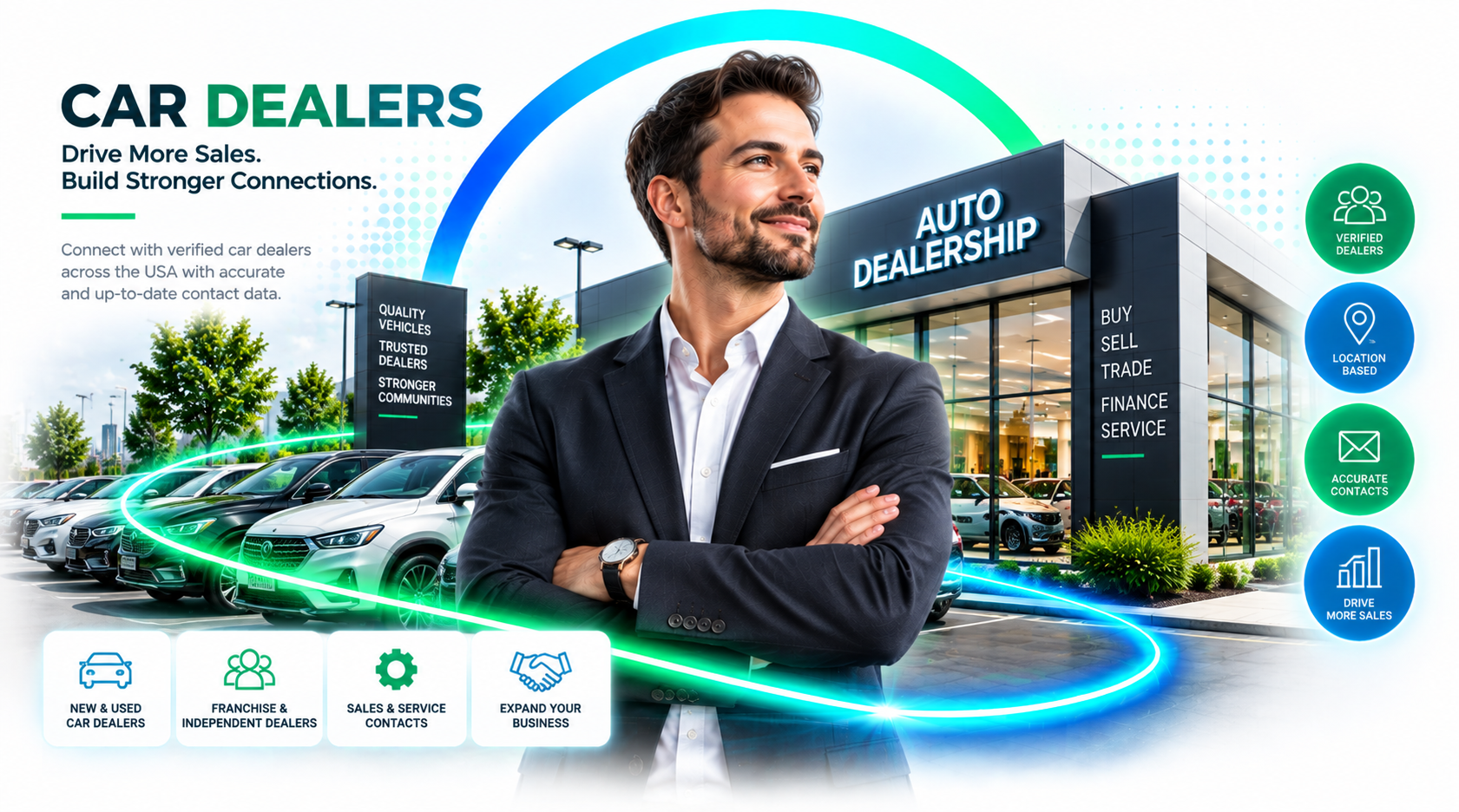
A Car Dealers Mailing List helps B2B companies identify and reach relevant contacts at franchised and independent car dealerships. Instead of targeting the entire automotive industry, businesses can focus on dealership owners, general managers, marketing leaders, service directors, and other professionals relevant to their products or services.
A targeted dealership contact database can support automotive software marketing, equipment sales, recruitment, financial services, cybersecurity outreach, and other B2B campaigns. By combining dealership type, location, department, job title, and other available business criteria, marketers can build a more relevant audience for their outreach.
In this guide, you’ll learn what dealership contact data includes, which decision-makers to target, how to segment a Car Dealers Mailing List, and how to evaluate data quality before launching a campaign.
What Is a Car Dealers Mailing List?
A Car Dealers Mailing List is a business-to-business contact database built around professionals and organizations operating in the car dealership sector.
Rather than a generic collection of automotive contacts, a well-built Car Dealers Mailing List is organized around the dealership itself: who works there, what they are responsible for, and how to reach them through relevant channels such as business email, direct phone lines, or mailing addresses.
It helps to separate three related but distinct categories of data:
- General automotive contact data covers the entire auto industry, including manufacturers, parts suppliers, repair shops, and dealerships combined, with little role-level detail.
- Car dealership contact data narrows the focus to dealership businesses specifically, typically at the company level (name, address, phone, website).
- Decision-maker-focused dealership marketing data goes a step further by identifying specific people and titles inside each dealership, such as a general manager or service director, so outreach can be addressed to a relevant individual rather than a general inbox.
The usefulness of any car dealership mailing list depends less on its size and more on audience relevance, the data fields it includes, how well it can be segmented, how often it is maintained, and whether it is used in a way that follows applicable marketing and privacy requirements. For a broader look at how email-specific dealership data is used, see our guide to the Car Dealers Email List.
Why Is a Car Dealers Mailing List Important for B2B Outreach?
A Car Dealers Mailing List matters because it lets businesses direct their message to dealership contacts who are actually relevant to their product or service, instead of sending the same automotive campaign to an unfiltered audience. This reduces wasted outreach and puts the message in front of people with a real reason to respond.
Dealership-focused outreach supports a wide range of B2B sellers, including:
- Automotive technology and dealership software companies
- CRM and customer engagement platforms
- Dealer management and operational solution providers
- Automotive marketing agencies and services
- Auto parts and equipment suppliers
- Financial and lending service providers
- Insurance providers serving dealerships
- Recruitment and staffing firms
- Training and consulting providers
- Cybersecurity and IT service providers
- Vehicle-related product and service companies
- General business and professional service firms
According to the National Automobile Dealers Association, the United States had 16,990 franchised light-vehicle dealerships in 2025, with total dealership sales topping $1.3 trillion and service and parts sales exceeding $164 billion (NADA Data). That scale means even a narrowly segmented dealership audience can represent a meaningful market. If your business is still assembling its first dealership contact database, our guide on how to build an effective Auto Dealers Mailing List covers the foundational steps.
What Information Can Be Included in a Car Dealers Mailing List?
Useful dealership contact data can include both professional details about individual contacts and company-level details about the dealership itself, though the exact fields available depend on the data source and how recently the records were verified.
| Data Field | How It Helps With Targeting | Example Marketing Application |
|---|---|---|
| Contact name | Allows personalized, direct outreach instead of a generic inbox message | Addressing an email to a named general manager rather than “info@dealer.com” |
| Job title | Identifies the recipient’s role and likely involvement in a purchase decision | Routing a service-related offer to a service manager instead of a sales manager |
| Business email | Provides a direct channel for outreach and follow-up | Sending a targeted email campaign to marketing directors |
| Company or dealership name | Confirms which dealership or dealer group the contact belongs to | Grouping contacts by dealership for account-based outreach |
| Business phone number | Supports direct calls for time-sensitive offers | Following up on a proposal with a scheduled call |
| Dealership location (city, state, ZIP code) | Enables geographic targeting for regional campaigns | Promoting a regional trade event to dealerships within a defined area |
| Website | Supports research and account context before outreach | Reviewing a dealership’s site before a first email or call |
| Dealership or company size | Helps match offers to the scale of the operation | Positioning enterprise software for larger dealer groups only |
| Employee range (where available) | Indicates operational scale and staffing needs | Targeting recruitment services toward larger stores |
| Seniority level | Distinguishes decision-makers from support staff | Reserving high-value offers for owner or executive-level contacts |
| Department | Clarifies which part of the dealership a contact manages | Sending finance and insurance offers to the F&I department |
| Franchise or dealership type (where available) | Distinguishes single-brand stores from multi-brand groups | Tailoring messaging for a specific OEM’s dealer network |
| Automotive specialization (where available) | Flags focus areas such as new, used, or EV sales | Promoting EV charging equipment to EV-focused dealerships |
Not every record will contain every field, since data completeness varies by dealership and by source. Businesses generally get better results by combining several fields, such as job title, department, and location, rather than relying on a single filter to define their audience.
Ready to Reach More Decision-Makers?
Access verified business decision-maker data worldwide. Filter, download and build targeted outreach lists in minutes—without manual scraping or guesswork.
Which Automotive Decision-Makers Should You Target at Car Dealerships?
The right automotive decision-maker to target depends on your product or service, who controls the relevant budget, and how that dealership’s buying process is structured. Larger dealer groups often split responsibility across several roles, while smaller independent dealerships may concentrate more decisions with the owner.
- Dealership owners and dealer principals hold ultimate authority over major purchases, vendor relationships, and long-term strategy.
- CEOs and presidents at larger dealer groups oversee multi-location strategy and high-level vendor decisions.
- General managers handle day-to-day operations and often approve technology, staffing, and vendor decisions at the store level. Our General Managers Email List guide covers this role in more depth.
- General sales managers and sales managers oversee vehicle sales performance and are relevant contacts for CRM, lead generation, and sales training offers.
- Marketing directors and marketing managers control advertising budgets and are the natural audience for automotive marketing services and platforms.
- Fixed operations leaders oversee the service and parts side of the business, including budget for equipment and software.
- Service directors and service managers manage day-to-day service department operations and staffing.
- Parts managers handle parts inventory, supplier relationships, and related purchasing.
- Finance and insurance leaders manage F&I products, lending partnerships, and compliance in that area.
- IT and technology decision-makers evaluate software, cybersecurity, and infrastructure vendors.
- Operations executives oversee cross-department efficiency, often at multi-location dealer groups.
- Human resources and recruitment leaders manage staffing needs and are relevant contacts for training and recruitment services.
Titles and day-to-day responsibilities vary considerably between independent dealerships and larger dealer groups, so it is worth confirming a contact’s actual role before assuming what a title implies.
How Can You Reach the Right Automotive Decision-Makers?
1. Define Your Ideal Dealership Audience
Start with the dealerships that fit your product or service. Consider whether you want to reach franchised or independent dealerships, single-location stores or larger dealer groups, specific states or regions, and the departments relevant to your offer.
2. Identify the Relevant Decision-Makers
Choose contacts based on the business problem you are solving. A dealership software provider may need general managers, operations leaders, or technology contacts, while an equipment supplier may focus on service or parts management.
3. Segment Contacts Before Outreach
Combine relevant filters such as dealership type, location, job title, department, and organization size where available. Smaller, clearly defined audiences make it easier to prepare relevant messaging.
4. Personalize the Message
Connect the offer to the recipient’s actual role and business context. Avoid assuming that every dealership has the same challenges, budget, or buying process.
5. Review, Test, and Measure
Check contact and company relevance before sending. Test different messages and audience segments, and measure qualified replies, meetings, opportunities, and sales outcomes rather than relying only on email opens.
How Should You Segment a Car Dealers Mailing List?
Segmentation means dividing your Car Dealers Mailing List into smaller, more relevant groups before you launch outreach, rather than sending one message to every contact at once.
Common segmentation criteria include:
- State, city, and ZIP code
- Broader geographic region
- Job title
- Seniority level
- Department
- Dealership size
- Other organization characteristics, such as single-location versus multi-location groups
- Dealership type (franchised or independent)
- Automotive business specialization, where available
Applying two or three of these criteria together, rather than relying on one, typically produces a more relevant audience and reduces the number of contacts who receive a message that has little to do with their role or market.
Best Practices for Using a Car Dealers Mailing List
Define a Clear Ideal Customer Profile
Identify the dealership characteristics, such as size, type, and location, that most closely match the businesses you already succeed with, and use that profile to guide list selection.
Match the Message to the Decision-Maker
Dealership owners, marketing leaders, operations leaders, and service managers each respond to different value propositions, so avoid using one generic message across every role.
Use Segmentation Before Sending Campaigns
Apply role, location, and organization filters before your first send rather than after, so each segment receives messaging built for its specific context from the start.
Prioritize Relevant and Responsible Outreach
Limit message frequency, avoid contacting the same dealership from multiple angles at once, and focus on contacts whose role genuinely relates to your offer.
Test Messaging and Audience Segments
Compare different value propositions, subject lines, and audience segments against each other to learn what resonates with specific dealership roles over time.
Measure Business Outcomes
Prioritize qualified conversations, meetings, and opportunities generated over vanity metrics such as raw open counts, which do not reliably indicate buying interest.
Follow Applicable Marketing and Privacy Requirements
Understand and follow the laws, regulations, and platform requirements that apply to your campaigns. In the United States, the CAN-SPAM Act applies to all commercial email, including business-to-business messages, and requires accurate sender information, non-deceptive subject lines, and a working opt-out mechanism honored within 10 business days (FTC CAN-SPAM Compliance Guide). Businesses contacting dealership employees in California should also note that the state’s business-contact exemption under the CCPA expired on January 1, 2023, meaning California business contact information is now treated as protected personal information under state law.
Follow Applicable Marketing and Privacy Requirements
Before using a Car Dealers Mailing List, review the marketing, privacy, and data-protection requirements that apply to your organization, the recipients, and the communication channel.
For commercial email in the United States, review the Federal Trade Commission’s CAN-SPAM compliance guidance, including requirements concerning sender identification, truthful subject lines, and opt-out mechanisms.
Businesses should also assess applicable state privacy laws and other relevant requirements before contacting dealership employees. Requirements can vary based on the jurisdiction, the type of information involved, and the purpose of processing. Consult qualified legal counsel when necessary.
Common Mistakes to Avoid When Targeting Car Dealerships
- Treating every dealership as the same: Independent single-location stores and large multi-brand dealer groups often have very different buying processes, so a one-size-fits-all approach tends to underperform.
- Contacting the wrong decision-maker: Sending a technology proposal to a sales manager instead of an IT decision-maker wastes the outreach; confirm the relevant role first.
- Using broad automotive targeting without segmentation: Casting a wide net across the entire automotive sector dilutes relevance compared with a dealership-specific, segmented audience.
- Sending generic dealership outreach: Messages that could apply to any industry rarely perform as well as ones that reference dealership-specific context.
- Relying on outdated or irrelevant contact information: Dealership staff turnover and ownership changes mean stale records lead to bounced emails and misdirected messages.
- Over-emailing prospects: Sending too many messages in a short period increases opt-outs and can damage sender reputation.
- Ignoring geographic differences: Regional market conditions, inventory trends, and local competition vary, so a message that works in one region may not fit another.
- Failing to test messaging: Sending a single version of a campaign without comparing alternatives limits what a team can learn for future outreach.
- Measuring success only through email opens: Opens are an unreliable indicator of interest; qualified replies and meetings are more meaningful signals.
- Ignoring applicable privacy and marketing requirements: Skipping opt-out handling or ignoring state-level privacy rules creates legal and deliverability risk.
How Can CampaignLake Help Businesses Reach Car Dealerships?
CampaignLake helps B2B businesses explore targeted dealership contact data for marketing, sales, and account-based outreach. Depending on the available dataset, businesses can use criteria such as job title, department, location, dealership characteristics, and company information to identify audiences relevant to their campaigns.
What Can Businesses Use the Data For?
Dealership contact data may support:
Automotive software and technology outreach.
Marketing agency prospecting.
Service and equipment supplier campaigns.
Recruitment and staffing outreach.
Financial and professional services prospecting.
Other B2B campaigns focused on dealership businesses.
What Should You Confirm Before Requesting a List?
Ask about the available fields, dealership coverage, data freshness, verification process, file format, segmentation options, and applicable usage requirements. The exact availability of these features depends on the specific CampaignLake dataset.
The objective is to build an audience that matches your campaign rather than selecting a list based only on the number of records.
TL;DR: Car Dealers Mailing List
- A Car Dealers Mailing List is a B2B contact database built around professionals and organizations at car dealerships.
- Targeting the right decision-maker, rather than a general dealership contact, improves the relevance of automotive B2B outreach.
- Segmenting by location, role, department, and dealership type produces more relevant audiences than a single broad filter.
- Key dealership roles include owners, general managers, sales managers, marketing managers, service directors, and F&I and IT leaders.
- Personalized messaging tied to a contact’s actual responsibilities tends to outperform generic, one-size-fits-all campaigns.
- Reviewing contact and company relevance before a campaign helps avoid outdated or mismatched targeting.
- CampaignLake helps businesses build targeted automotive B2B audiences aligned to a specific campaign goal.
Car Dealers Mailing List Checklist
- Define your ideal dealership audience based on type, size, location, and specialization.
- Identify the relevant automotive decision-makers for your specific product or service.
- Segment contacts by location, role, and organization characteristics before launching outreach.
- Match messaging to the recipient’s actual responsibilities and likely priorities.
- Test campaigns and measure qualified business outcomes rather than surface-level metrics.
Frequently Asked Questions
A Car Dealers Mailing List is a business-to-business contact database that includes professionals and organizations at car dealerships. It typically combines company-level details, such as dealership name, address, and website, with role-level details like job title and department that identify specific decision-makers so outreach can be addressed to a relevant person rather than a general inbox.
Common targets include dealership owners and dealer principals, general managers, general sales managers, marketing directors and managers, service directors, parts managers, finance and insurance leaders, IT and technology decision-makers, and operations or human resources leaders, with the right role depending on what is being offered.
Businesses can segment a Car Dealers Mailing List by geographic factors such as state, city, or ZIP code, by job role and seniority level, by department, and by organization characteristics such as dealership size, franchise or dealership type, and automotive specialization where that information is available in the data.
Yes. A Car Dealers Mailing List is built specifically for B2B marketing use cases, including targeted email outreach, direct mail campaigns, and account-based marketing aimed at dealership decision-makers, rather than for reaching individual consumers who are shopping for a vehicle.
Typical fields include contact name, job title, business email address, business phone number, dealership name, city, state, ZIP code, website, company or dealership size, seniority level, and department, though data completeness varies by source and not every record contains every field.
Businesses reach automotive decision-makers more effectively by defining a clear target dealership audience, segmenting contacts by job role and department, personalizing messaging around relevant business challenges, reviewing contact and company information for accuracy before launching, and measuring qualified outcomes rather than surface-level engagement metrics.
Segmentation is important because dealerships vary widely in size, structure, and specialization, and different roles within the same dealership have different priorities and budgets. A segmented approach lets businesses tailor messaging to what each contact actually cares about, which tends to produce more relevant, better-received outreach.
Businesses should confirm CAN-SPAM compliance, including accurate sender identification, a non-deceptive subject line, and a working opt-out mechanism honored within the required timeframe. They should also consider state-level privacy requirements, such as California’s protections for business contact information, before launching a campaign.
CampaignLake helps businesses define and build automotive B2B audiences using criteria such as job title, seniority, department, location, and dealership characteristics. The goal is aligning the resulting Car Dealers Mailing List to a specific campaign objective rather than relying on a broad, unfiltered automotive contact list.
Conclusion
A Car Dealers Mailing List can help B2B businesses identify relevant dealership contacts and organize more focused outreach. The most useful approach begins with a clear ideal customer profile, continues with role- and dealership-specific segmentation, and includes a review of contact relevance, data quality, and applicable marketing requirements.
Whether you are promoting dealership software, service equipment, marketing services, recruitment, or another B2B offer, choosing contacts based on the actual business need is more useful than relying on a broad automotive audience.
If you are planning a dealership-focused campaign, explore CampaignLake’s Car Dealers Mailing List options to review available data fields, targeting criteria, and the next steps for requesting a relevant audience.