Follow us on :

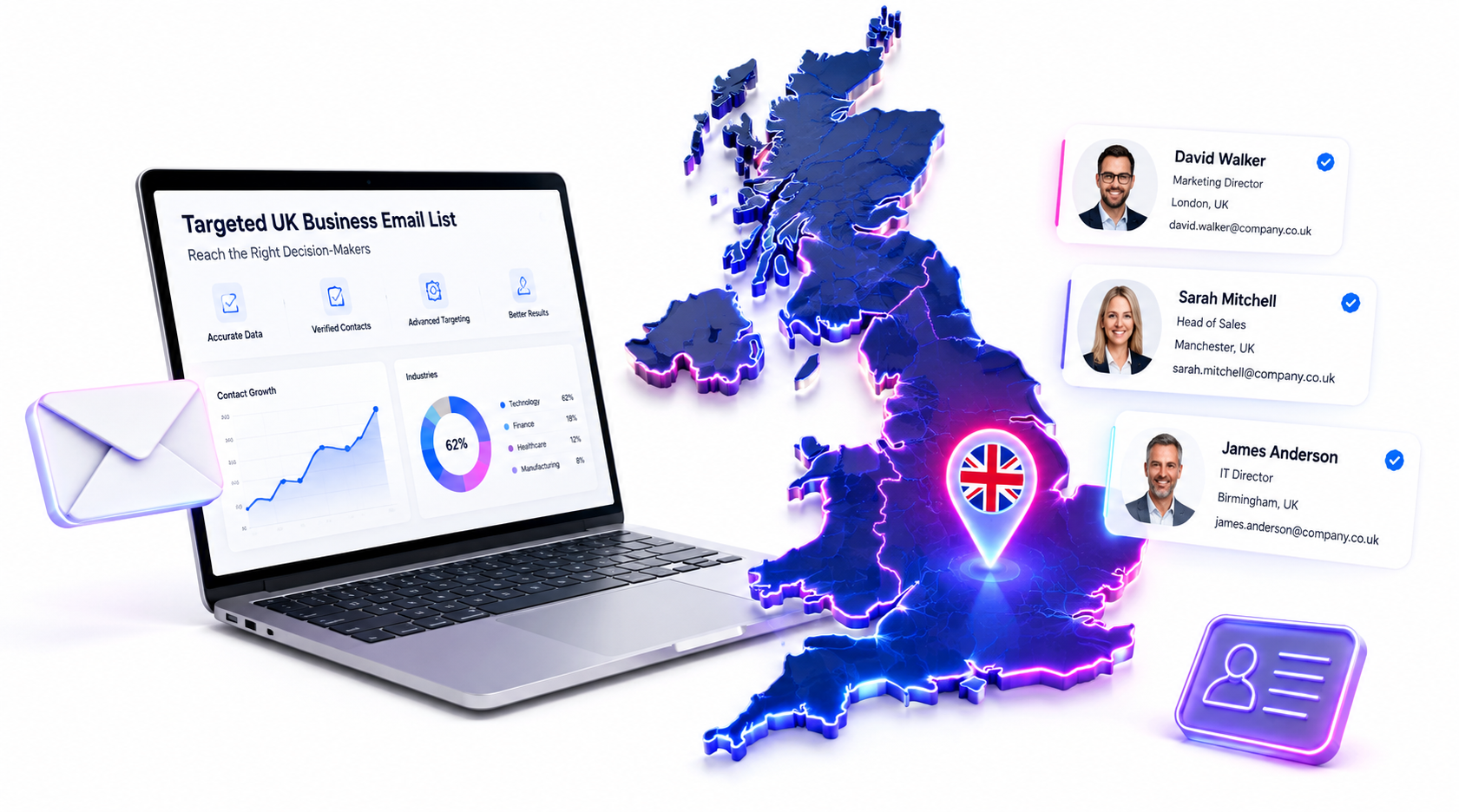
Finding the right business prospects is becoming increasingly important for B2B companies targeting the UK market. Sending campaigns to a large but poorly defined audience can waste sales resources, reduce engagement, and make it harder to identify genuinely relevant opportunities.
A targeted UK business email list helps businesses focus on companies and decision-makers that match specific campaign requirements. Instead of searching for contacts one company at a time, marketers can segment a business audience using criteria such as industry, job title, company size, location, revenue, employee count, and technology usage.
Whether your goal is B2B lead generation, sales prospecting, account-based marketing, event promotion, or market expansion, the quality of your audience can have a significant impact on campaign relevance.
A targeted UK business email list is a structured database of business contacts that can be segmented according to specific audience criteria.
Depending on the campaign and available data, a UK business list may include information such as:
The purpose of targeting is not simply to find more contacts. It is to identify a more relevant audience for a specific business objective.
For example, a company selling cybersecurity solutions may not need to reach every UK business. Its ideal audience could be technology leaders and IT decision-makers working at medium-sized and enterprise organisations in selected industries.
The more clearly a target audience is defined, the easier it becomes to build focused campaigns.
A large business database does not automatically create a valuable marketing audience.
A list containing thousands of contacts may still produce poor results if the companies, job roles, or business needs are not relevant to the offer.
Targeting helps B2B marketers narrow their audience based on characteristics that matter to their sales and marketing strategy.
A Targeted Business Audience Can Help You:
A message written specifically for a particular industry or job function is usually more relevant than a generic campaign sent to multiple unrelated audiences.
Sales teams can spend more time researching and engaging with companies that match their ideal customer profile.
Businesses can build lists around selected companies and identify multiple relevant stakeholders within those organisations.
Different industries, company sizes, and job functions often have different priorities. Segmentation makes it easier to adapt messaging accordingly.
Companies entering new UK regions or industries can identify audiences based on specific geographic and business criteria.
The objective should therefore be:
Reach the right companies → identify relevant people → create relevant messaging → maintain data quality.
Access CampaignLake's Industry-Specific Email Database
Building an effective UK B2B audience requires more than collecting email addresses.
The process should begin with audience strategy.
Before collecting or sourcing business contacts, define the type of company most likely to be relevant to your products or services.
An ideal customer profile may include:
For example, a B2B software provider could define its target audience as:
UK technology and professional services companies with 100–1,000 employees, targeting IT Directors, CIOs, CTOs, and other technology decision-makers.
This is much more useful than targeting every business with a generic technology-related message.
A clearly defined ICP becomes the foundation for every other targeting decision.
Once you know who you want to reach, the next step is to determine how your business database should be segmented.
The best segmentation criteria depend on your offer.
Industry targeting is one of the most common ways to build a focused B2B audience.
Examples include:
Industry segmentation allows businesses to create campaigns that address sector-specific challenges.
For example, a technology solution designed for hospitals may require different messaging than the same solution promoted to financial institutions.
Job title targeting helps identify professionals based on their role and level of responsibility.
Depending on your campaign, relevant contacts may include:
However, job titles alone should not determine your targeting strategy.
Different organisations use different titles for similar responsibilities.
For this reason, combining job titles with additional criteria such as department and seniority can create a more useful audience.
Seniority can help distinguish between strategic decision-makers and operational users.
Common seniority levels include:
A B2B buying decision may involve multiple levels of seniority.
For example, an IT product could involve:
Targeting multiple relevant stakeholders can be useful when building account-based campaigns.
Company size can influence:
Businesses can be segmented by employee count or other available company-size indicators.
For example:
| Company Segment | Example Targeting Approach |
|---|---|
| Small Businesses | Owners and Managing Directors |
| Mid-Market Companies | Department Heads and Directors |
| Enterprise Organisations | Multiple Decision-Makers and Buying Committees |
A solution designed for small businesses may require completely different targeting than an enterprise product.
Geographic targeting can be useful for regional sales strategies, events, field marketing, and location-specific services.
Businesses may target:
Location can also be combined with industry or job title targeting.
For example:
Financial services companies in London with 100+ employees, targeting senior marketing decision-makers.
Combining multiple filters generally creates a more specific audience than relying on location alone.
Technology-based segmentation can be particularly useful for software, IT, consulting, and technology service providers.
Depending on available data, businesses may be segmented based on:
For example, a consulting company specialising in ERP implementation could focus its campaign on organisations using relevant enterprise software environments.
Technology targeting can help create highly specific campaigns when the technology itself is relevant to the service being promoted.
One of the biggest mistakes in B2B prospecting is assuming that every contact at a company has the same influence over a purchase.
Most business purchases involve different types of stakeholders.
These may include:
Senior leaders responsible for approving budgets or major business investments.
Examples:
Leaders responsible for evaluating solutions within a specific function.
Examples:
Professionals who may research, evaluate, or recommend solutions.
Examples:
Employees who may use the product or service directly.
The right audience often depends on what you sell.
| Business Goal | Potential Contacts |
|---|---|
| Software Solutions | CIO, CTO, IT Director |
| Marketing Services | CMO, Marketing Director |
| Financial Solutions | CFO, Finance Director |
| Recruitment Services | HR Director, Talent Lead |
| Business Consulting | CEO, Managing Director |
| Procurement Solutions | Procurement Director, Purchasing Manager |
Rather than asking, “Who has the highest title?”, ask:
“Who is most likely to influence, evaluate, approve, or use this solution?”
That approach usually produces a more realistic B2B audience.
There are several ways businesses can develop a UK business audience.
These may include:
Each approach has different advantages and limitations.
Building a list internally can provide strong control over research and audience selection.
However, the process can be time-consuming, particularly when targeting thousands of companies across multiple industries or regions.
Internal teams may need to research:
This can be suitable for highly specialised or smaller campaigns.
First-party data may be generated through:
Businesses should clearly communicate how information will be used for marketing and maintain appropriate records of consent where consent is relied upon.
For larger campaigns, businesses may use a specialist provider to build a targeted audience based on specific requirements.
Before using a third-party list or data source, organisations should evaluate factors such as:
The ICO advises organisations to make appropriate checks when using marketing lists and to satisfy themselves about matters such as accuracy and fair collection.
Business information changes continuously.
People change jobs. Companies restructure. Email addresses become inactive. Businesses close or change ownership.
For this reason, list building should not be treated as a one-time project.
A data maintenance process may include:
There is no single update schedule that works for every database.
The appropriate frequency depends on factors such as:
Businesses that rely heavily on outbound prospecting may need more frequent data quality reviews than organisations using a list only for occasional campaigns.
The key principle is to treat business data as dynamic rather than permanent.
A database becomes more valuable when it can be divided into meaningful audiences.
Instead of sending one campaign to an entire list, marketers can create segments based on specific characteristics.
Target Audience:
Campaign Angle:
Improving operational efficiency and reducing process complexity.
Target Audience:
Campaign Angle:
Marketing solutions designed around industry-specific challenges.
Target Audience:
Campaign Angle:
Integration, migration, optimisation, or complementary services.
Target Audience:
Campaign Angle:
Highly personalised outreach based on company-specific needs.
The answer depends on your target market, resources, and campaign scale.
| Factor | Build Internally | Use a Data Provider |
|---|---|---|
| Research Time | Higher | Potentially Lower |
| Scalability | Limited by Internal Resources | Can Support Larger Campaigns |
| Customisation | Highly Manual | Depends on Available Segmentation |
| Data Maintenance | Internal Responsibility | Depends on Provider |
| Initial Campaign Speed | Often Slower | Potentially Faster |
| Audience Size | Usually More Limited | May Offer Broader Coverage |
Build Your Own List When:
Consider a Specialist Data Provider When:
The best option depends on campaign objectives rather than assuming that one approach is always better.
The usefulness of a business database depends on the information needed for segmentation and outreach.
Potential data fields may include:
| Data Category | Example Information |
|---|---|
| Contact Information | Name and Business Email |
| Professional Role | Job Title and Department |
| Seniority | Manager, Director, C-Suite |
| Company | Business Name |
| Industry | Sector or Industry Classification |
| Company Size | Employee Range |
| Revenue | Revenue Range Where Available |
| Location | City, Region or UK Area |
| Website | Company Website |
| Technology | Relevant Technology Information |
| Contact Preferences | Opt-Out or Suppression Status |
Not every campaign requires every field.
The best database is one that contains information relevant to the audience and campaign strategy.
Businesses using UK business contact data for marketing should understand that B2B marketing is not automatically outside UK data protection requirements.
The ICO explains that UK GDPR can apply when personal data is processed in a business context, including situations involving identifiable business contacts. PECR requirements can also differ depending on factors such as the communication method and whether the recipient is classified as a corporate or individual subscriber.
For example, ICO guidance distinguishes between corporate subscribers and certain business types such as sole traders and some partnerships, which may receive different treatment under electronic marketing rules.
Businesses should therefore consider:
The ICO notes that consent and legitimate interests are among the lawful bases most commonly relevant to direct marketing, depending on the circumstances and applicable requirements. Legitimate interests is not automatic and requires an organisation to assess its specific circumstances.
1. Targeting Everyone
A broad audience may appear attractive because it offers more potential contacts.
However, a large audience with limited relevance can create inefficient campaigns.
Start with your ideal customer profile.
2. Focusing Only on Email Volume
The number of contacts should not be the primary measure of audience quality.
A smaller, well-defined audience can be more useful than a much larger but unrelated database.
3. Ignoring Job Function
A company may be relevant while the selected contact is not.
Target both the right companies and the right stakeholders.
4. Using Outdated Information
Business contact data changes over time.
Regular verification and maintenance are important parts of list management.
5. Ignoring Segmentation
Sending identical messages to multiple unrelated industries or job roles can reduce relevance.
Create audience-specific campaigns wherever practical.
6. Forgetting About Opt-Outs and Objections
Direct marketing processes should include a clear process for handling opt-outs and objections.
The ICO states that individuals have an absolute right to object to the processing of their personal data for direct marketing purposes, and organisations must stop processing that personal data for that purpose when such an objection applies.
A targeted audience can support several business growth activities.
Sales Prospecting: Sales teams can identify companies and relevant stakeholders matching their ideal customer profile.
Account-Based Marketing: Marketers can build campaigns around selected target accounts and multiple stakeholders within those organisations.
Email Campaign Segmentation: Contacts can be divided based on industry, role, company size, or other relevant criteria.
Event and Webinar Promotion: Businesses can identify professionals who may be relevant to a particular event topic.
Market Expansion: Companies entering new UK regions or industries can identify potential business audiences based on geographic and sector-specific targeting.
Building a B2B prospecting audience manually can require significant time, particularly when campaigns involve multiple industries, regions, company sizes, and decision-maker categories.
CampaignLake helps businesses explore targeted business audiences based on campaign requirements.
Depending on the available targeting options, businesses can build audiences using criteria such as:
Rather than using a generic audience for every campaign, marketers can define the companies and professionals they want to reach and create more specific B2B segments.
Businesses should consider data quality, relevance, sourcing, transparency, lawful processing, applicable electronic marketing requirements, and processes for handling opt-outs or objections. ICO guidance should be reviewed in relation to the organisation’s specific marketing activities.
The most effective UK business email list is not necessarily the largest.
It is the audience that most closely matches your business objectives.
Start by defining your ideal customer profile. Identify the industries and companies most relevant to your offer. Find the decision-makers and stakeholders involved in the buying process. Segment the audience based on meaningful business criteria. Maintain data quality and ensure your marketing practices are appropriate for your specific circumstances.
A more focused approach can help sales and marketing teams spend less time searching through irrelevant prospects and more time engaging with companies that fit their target market.
Ready to Reach More Decision-Makers?
Access verified business decision-maker data worldwide. Filter, download and build targeted outreach lists in minutes—without manual scraping or guesswork.

Ben Williams is a leading voice in B2B email marketing and data-driven lead generation. Known for his strategic mindset and deep understanding of high-performance email lists, Ben helps businesses cut through the noise and connect with their ideal audience. With a background rooted in growth marketing and sales enablement, he transforms raw data into revenue-generating campaigns that consistently deliver results. His work empowers organizations to streamline prospecting, boost conversions, and maximize ROI. Beyond the inbox, Ben stays at the forefront of emerging trends in data intelligence and B2B engagement, always seeking innovative ways to elevate campaign performance.