Follow us on :

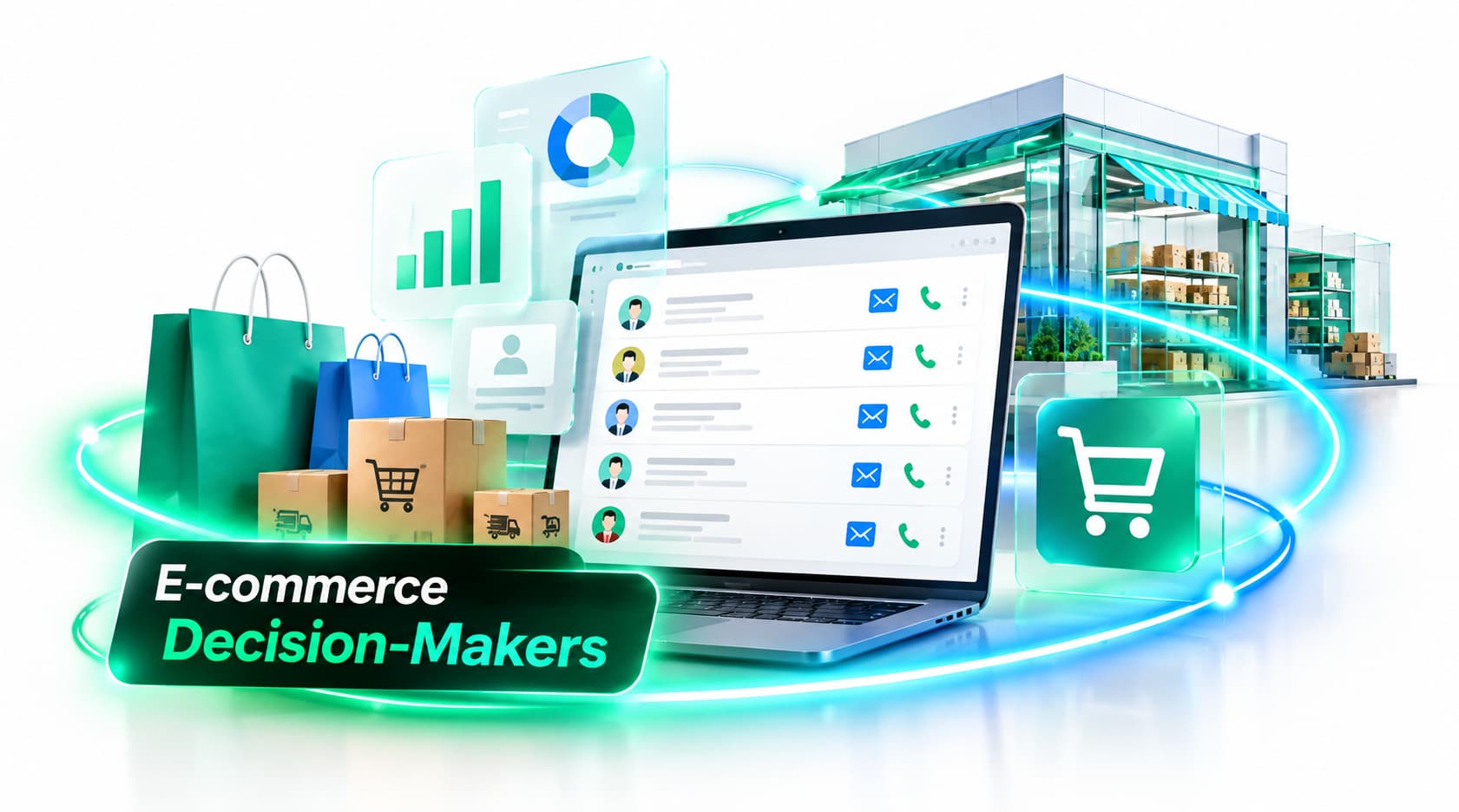
The e-commerce industry creates opportunities for businesses selling software, digital marketing services, payment solutions, logistics, fulfillment, and other B2B products. However, reaching the right online retailers and e-commerce decision-makers remains a challenge when prospecting relies on broad, outdated, or poorly segmented contact data.
An e-commerce industry email list helps B2B companies identify relevant businesses and professional contacts for targeted prospecting, sales outreach, and business development. Depending on the provider, a list may include business email addresses, contact names, job titles, company information, phone numbers, geographic details, and other firmographic attributes.
The key is not simply obtaining more contacts. It is identifying the businesses that fit your ideal customer profile, reaching the professionals who influence purchasing decisions, and delivering messages that address their actual business needs.
In this guide, you’ll learn how e-commerce contact lists work, which decision-makers you can target, how to evaluate data providers, and how to use segmented business contact data to build a more effective B2B lead-generation strategy in 2026.
An e-commerce industry email list is a collection of business contact records associated with online retailers, digital commerce companies, marketplace sellers, direct-to-consumer brands, and other businesses that sell products or services through online channels.
These lists help B2B sales and marketing teams identify potential customers, partners, and business opportunities within the digital commerce ecosystem.
Depending on the provider and available records, an e-commerce email list may include:
Not every provider supplies every field. Buyers should verify which data points are included, how recently they were checked, and whether the records match their intended audience.
For example, a marketing automation company targeting growing online retailers may need e-commerce founders and marketing directors. A warehouse technology provider may prioritize operations managers and fulfillment leaders. Although both companies serve the e-commerce industry, their ideal contact lists are different.
The most useful e-commerce email list is one built around your target customers, not simply the largest number of available records.
E-commerce businesses have different organizational structures, purchasing responsibilities, and operational priorities. Identifying the right professional is therefore an essential part of building a qualified prospect list.
Founders, owners, and managing directors often influence purchasing decisions at small and midsized online businesses. They may evaluate marketing agencies, payment providers, software platforms, logistics partners, and other services that support growth.
This audience is particularly relevant for B2B companies selling solutions that help online businesses increase sales, reduce operating costs, or improve efficiency.
Marketing leaders oversee customer acquisition, advertising, conversion optimization, email marketing, and customer retention.
They may be suitable prospects for marketing automation platforms, analytics software, advertising services, customer data solutions, and digital marketing agencies.
For these campaigns, targeting marketing and growth professionals is generally more relevant than contacting every employee at an online retailer.
Technology leaders evaluate and manage the systems that support online commerce. Depending on the company, these professionals may be responsible for integrations, platform performance, cybersecurity, data infrastructure, and software procurement.
Technology vendors can use role-based targeting to identify contacts whose responsibilities align with their solutions.
Operations leaders oversee inventory management, order processing, shipping coordination, returns, and fulfillment workflows.
They may be relevant prospects for warehouse management systems, shipping software, inventory platforms, packaging solutions, and logistics services.
Procurement managers, finance directors, and other purchasing stakeholders may influence decisions involving payment infrastructure, business services, enterprise software, and operational suppliers.
For larger e-commerce organizations, it can be helpful to identify both the person evaluating a solution and the person responsible for approving the purchase.
Some businesses sell through third-party marketplaces, while others operate independent online stores or use several sales channels.
Marketplace managers, platform specialists, and digital commerce professionals may be relevant to companies offering listing optimization, marketplace analytics, seller software, and channel management solutions.
The important distinction is that a job title indicates potential relevance, not confirmed buying intent. Strong prospecting combines role, company fit, business context, and a relevant offer.
Access CampaignLake's Industry-Specific Email Database
An e-commerce industry email list can cover several business models. Understanding these segments helps B2B companies prioritize the prospects most likely to benefit from their offerings.
These companies sell products through their own websites or digital storefronts. Depending on their size and operating model, they may need payment processing, customer support technology, advertising services, inventory software, and fulfillment solutions.
Online businesses use platforms such as Shopify, WooCommerce, Magento, and BigCommerce to operate their digital storefronts.
Platform-specific targeting can be useful for companies offering compatible applications, integrations, store development, conversion optimization, or specialized e-commerce services.
However, platform information should be checked for accuracy and recency rather than assumed from incomplete technology signals.
Direct-to-consumer (DTC) businesses sell products directly to customers, often through their own websites and digital marketing channels.
Relevant B2B offerings may include customer retention platforms, subscription management software, packaging, logistics, product analytics, and marketing services.
Marketplace sellers operate through platforms such as Amazon and other online marketplaces.
Potential solutions include inventory management, pricing tools, advertising services, marketplace analytics, order management, and fulfillment support.
B2B e-commerce businesses sell products or services to other companies through online ordering systems, digital catalogs, or commerce portals.
These organizations may need customer relationship management, procurement integrations, payment automation, distributor management, and digital sales technology.
Segmenting these groups helps businesses create more relevant campaigns instead of sending the same message to every company associated with online commerce.
A targeted contact list can support several stages of the B2B sales process when its data is appropriate for the intended use.
A carefully defined list helps sales teams focus on businesses that match their ideal customer profile. This can reduce time spent researching unrelated accounts and improve the relevance of prospecting efforts.
Contact data that includes professional roles and company information can help teams identify people who may influence a purchasing decision.
The appropriate contact depends on the product, company size, purchasing process, and target market.
Segmentation makes it easier to tailor messaging to different business needs. A message about reducing shipping costs, for example, may be more relevant to an operations leader than to a finance professional evaluating marketing software.
Companies entering new markets can use appropriately sourced business contact data to identify potential customers in selected countries or regions.
Geographic targeting should account for differences in purchasing behavior, language, local market conditions, and applicable privacy and marketing requirements.
E-commerce contact data can help identify potential technology partners, agencies, service providers, and target accounts for account-based marketing (ABM).
Rather than contacting every available record, teams can prioritize organizations that fit their partnership or sales objectives.
A structured contact database can reduce repetitive research when it includes useful, current company and contact information. Sales representatives can then spend more time evaluating opportunities, researching business needs, and having meaningful conversations.
These benefits are not automatic. Results depend on data quality, audience fit, messaging, offer relevance, outreach practices, and the ability to qualify interested prospects.
E-commerce contact data is useful to a range of B2B companies whose products or services support online retail operations.
E-commerce software and SaaS providers: Identify relevant founders, technology leaders, and digital commerce managers who may need new software or integrations.
Digital marketing agencies: Reach online retailers that fit a specific service offering, such as paid advertising, conversion optimization, SEO, or customer retention.
Payment and fintech providers: Identify businesses for which payment processing, transaction management, fraud prevention, or financial automation may be relevant.
Shipping and fulfillment companies: Target operations leaders and businesses whose order volume, geography, or fulfillment model fits the provider’s capabilities.
Inventory and warehouse technology vendors: Reach companies that may benefit from inventory visibility, warehouse automation, order management, or demand planning.
Cybersecurity providers: Identify appropriate IT and security stakeholders at online businesses with relevant technology requirements.
Packaging and product suppliers: Reach online retailers and DTC brands that fit their product categories, distribution capabilities, and commercial requirements.
Retail technology companies: Identify businesses that may need commerce integrations, analytics, customer relationship management, or omnichannel solutions.
For example, a company selling shipping software could prioritize operations managers at online retailers. A customer retention platform might focus on e-commerce marketing directors. This simple difference can make prospecting more relevant from the first interaction.
Building a useful prospect database starts with a clear audience definition and continues through data evaluation, segmentation, and ongoing maintenance.
Start by identifying the types of businesses most likely to benefit from your product or service.
Consider:
Avoid defining your audience solely by industry. Two e-commerce companies may operate in the same category but have very different requirements, budgets, and purchasing processes.
Map the business problem your product solves to the professional most likely to evaluate or purchase the solution.
For example, an inventory platform may be relevant to operations leaders, while an advertising analytics tool may be more suitable for marketing and growth teams.
Include multiple stakeholders when the purchasing process involves technical evaluation, budget approval, and operational implementation.
Use available data fields to narrow your audience by company type, location, employee size, revenue range, product category, or technology platform.
The filters you select should reflect your ideal customer profile rather than simply reducing the size of the list.
Potential sources include first-party business relationships, relevant professional directories, company websites, research providers, and third-party B2B data vendors.
Evaluate each source based on its reliability, permitted use, coverage, and suitability for the intended campaign.
Public availability alone does not establish permission to send marketing messages.
Check for invalid email addresses, duplicates, outdated job titles, incorrect company associations, and missing information.
Ask providers how verification is performed and when the data was last updated. Email verification can help identify technical risks, but it cannot guarantee that a contact is relevant, that a person will respond, or that a message may legally be sent.
Separate prospects into relevant audiences, such as DTC founders, Shopify merchants, e-commerce marketing directors, or logistics decision-makers.
This makes it easier to create tailored messages and evaluate campaign performance by segment.
Business contact information changes as employees move roles, companies expand, and technology requirements evolve.
Review records periodically, suppress invalid contacts and opt-outs, and update important fields when reliable information becomes available.
A prospect database should be maintained as an ongoing business resource rather than treated as a permanent snapshot of the market.
Choosing a provider requires more than comparing headline contact counts. The goal is to obtain data that matches your audience, meets your operational needs, and can be used appropriately.
Ask how the provider checks email addresses, phone numbers, professional roles, and company information.
Find out whether verification is performed before delivery, whether timestamps are available, and what happens when records are inaccurate.
Avoid treating a provider’s advertised accuracy or deliverability percentage as a universal guarantee. Ask how the metric is defined, measured, and supported.
Contact data can become outdated when people change jobs, businesses close, or companies change their contact information.
Ask when the records were last checked and whether the provider can supply a verification date or explain its refresh process.
Recent verification is useful, but it does not eliminate the need to validate data before an important campaign.
Confirm that the provider can identify the business types and roles relevant to your offer.
Useful segmentation fields may include geography, industry, job title, seniority, company size, revenue range, product category, and technology platform, where available.
A sample lets you examine actual field coverage and determine whether the records match your requirements.
Check for relevant job titles, accurate company associations, useful business details, duplicates, and missing fields before purchasing a larger dataset.
A representative sample is more informative than relying on a headline claim about the total number of contacts.
Ask where the information originates, what rights and restrictions apply to its use, and what documentation the provider can supply.
The buyer should independently assess the legal basis and requirements for the intended processing and outreach. A provider’s compliance statement does not automatically authorize every marketing use.
Check whether the data can be delivered in CSV or Excel format and whether the fields can be mapped to your CRM or sales workflow.
Consistent field names, clear company identifiers, and documented verification dates can simplify importing and maintaining the database.
Some campaigns require a narrowly defined group of businesses or professional roles rather than a broad, ready-made list.
Ask whether the provider can help refine the audience, explain available filters, and clarify the limitations of its coverage.
The best provider is the one that can demonstrate a suitable match for your requirements—not necessarily the one advertising the largest database.
Before purchasing a list, use a structured review to understand what you are receiving.
First, define the required fields. Decide whether you need business email addresses, direct phone numbers, job titles, company websites, geographic information, or other attributes.
Second, review a representative sample. Confirm that the records match your intended audience and that the supplied fields are complete enough for your workflow.
Third, check verification methods. Ask whether email verification, duplicate removal, and company or job-title checks are included.
Fourth, review timestamps and sourcing. Establish when the data was last checked and what information is available about its origin.
Fifth, confirm the terms of use. Understand the permitted uses, applicable restrictions, and any requirements relating to privacy, consent, or direct marketing.
Finally, measure practical suitability. Test an appropriate subset through your normal data-quality process before relying on a larger dataset.
It is important to distinguish four separate questions:
Is the email address technically valid?
Is the contact information accurate and current?
Is the person or business relevant to the campaign?
Is the intended processing and outreach permitted?
A positive answer to one question does not automatically answer the others.
Segmentation helps businesses move from broad prospecting to more relevant communication.
Separate online retailers, DTC brands, marketplace sellers, B2B commerce companies, and other relevant categories.
Each business model may have different operational requirements and purchasing priorities.
Group founders, marketing directors, operations managers, technology leaders, and procurement professionals according to the solution being offered.
This helps align the message with the recipient’s responsibilities.
Smaller online businesses may prioritize simplicity and affordability, while larger companies may require integrations, security reviews, and more complex implementation.
Company size is a useful indicator, but it should not be treated as proof of budget or purchase intent.
Organize prospects by relevant countries, regions, or states.
Use accurate location information and account for the marketing rules that apply to each destination.
Where reliable technology data is available, identify businesses using relevant platforms.
This can be especially useful for software vendors, app developers, implementation agencies, and integration providers.
Create segments around legitimate, relevant business requirements—for example, inventory management, shipping coordination, marketing automation, or customer retention.
The more closely the segment aligns with the offer, the easier it becomes to write a useful message.
A targeted list provides the starting point for prospecting. Turning that data into qualified opportunities requires a thoughtful outreach process.
Choose a specific segment rather than sending the same message to every contact.
For example, a provider of fulfillment software could start with operations managers at online retailers that fit its service area and business requirements.
Define the audience, intended business problem, offer, and desired next step before writing the message.
Use accurate company information and professional responsibilities to make the message more useful.
Avoid generic introductions that could apply to any business. Explain why the solution may be relevant to the recipient’s role or operating model without pretending to know private information or an unconfirmed business problem.
Describe the problem your product addresses rather than listing every feature.
A logistics software provider might explain how its platform supports shipment visibility or reduces manual coordination. A marketing agency might describe its approach to improving campaign measurement.
Claims about savings, performance, and results should be supported by evidence.
Choose a simple next step, such as reviewing a relevant case study, discussing requirements, or arranging a product demonstration.
Avoid giving the recipient several unrelated actions to complete in the same message.
Where outreach is lawful and appropriate, use a limited follow-up sequence that adds useful context instead of repeating the original pitch.
Honor objections and opt-out requests, and avoid contacting people who should be suppressed from future campaigns.
Evaluate campaign performance using several indicators:
Delivery and hard-bounce rates
Positive reply rates
Qualified leads generated
Meetings booked and attended
Sales opportunities created
Conversions and revenue where measurable
Open rates can be affected by privacy features and automated activity, so they should not be treated as a definitive measure of interest.
Use the results to improve audience selection, messaging, and qualification rather than assuming that more contacts will always produce better outcomes.
Even a well-organized database can produce disappointing results when it is used without a clear strategy.
Buying based on volume alone: A large list may contain many contacts who do not match your ideal customer profile.
Ignoring the recipient’s role: A technically relevant company may still be the wrong target if the contact has no responsibility for the problem your product solves.
Using outdated data: Incorrect addresses, job changes, and duplicate records can waste sales resources and create deliverability risks.
Sending identical messages to every segment: Different business models and professional roles often require different messaging.
Assuming list ownership means consent: Acquiring contact information does not automatically provide permission to use it for every type of marketing.
Making unsupported claims: Promises of guaranteed leads, conversions, accuracy, or deliverability can create unrealistic expectations.
Ignoring negative feedback and opt-outs: Continuing outreach after an objection can damage trust and create compliance problems.
Measuring only email volume: The real objective is to generate relevant conversations and qualified business opportunities, not simply send more messages.
Building your own database and working with a third-party B2B data provider serve different purposes.
An internally developed database can be built through customer relationships, inbound inquiries, event interactions, and other appropriate first-party collection methods. It gives the organization greater control over the context in which information was collected and the associated preferences and records.
A third-party e-commerce contact list may help identify additional businesses and professional contacts beyond an existing network. Its usefulness depends on coverage, accuracy, sourcing, permitted use, and the buyer’s ability to identify suitable prospects.
The two approaches can complement one another. A company might use first-party data to understand its strongest customer segments, then use appropriately sourced business contact information to research additional accounts that fit those segments.
One distinction is essential: a purchased or licensed contact list should not automatically be treated as an opted-in newsletter subscriber list. Permission requirements and permitted uses must be evaluated separately.
Data quality and responsible outreach are important parts of a sustainable B2B prospecting strategy. Businesses should review the rules applicable to the recipients, communication method, data processing, and intended use.
The CAN-SPAM Act applies to commercial email, including business-to-business promotional messages. Requirements include accurate sender information, non-deceptive subject lines, a valid postal address, a functioning opt-out method, and timely handling of opt-out requests.
The Federal Trade Commission provides a CAN-SPAM compliance guide for businesses.
UK GDPR and the Privacy and Electronic Communications Regulations (PECR) may apply to B2B marketing, depending on the recipient and communication method. Rules can differ between corporate subscribers and individuals, including sole traders and certain partnerships.
The Information Commissioner’s Office provides guidance on direct marketing using electronic mail and using marketing lists.
Businesses operating internationally should evaluate applicable data protection laws and national electronic-marketing rules in each target market. Requirements can vary based on the type of recipient, the communication, the processing involved, and the circumstances in which the contact data was obtained.
Before launching a campaign, review the provider’s sourcing documentation, establish an appropriate basis for processing where required, confirm the permitted use of the data, and maintain suppression records for opt-outs and objections.
Important: A provider’s statement that a list is compliant does not, by itself, make every subsequent use of that data lawful. Organizations remain responsible for assessing their own activities and obligations.
An e-commerce industry email list is a collection of business contact records associated with online retailers, digital commerce companies, marketplace sellers, and related businesses. Depending on the provider, it may contain professional email addresses, names, job titles, company information, phone numbers, and geographic details for B2B prospecting.
You can explore specialist B2B data providers, relevant business directories, company websites, and appropriate first-party research sources. Before purchasing a list, evaluate its contact coverage, verification methods, freshness, sourcing documentation, segmentation options, and permitted uses.
Yes, if the provider offers reliable Shopify-related business segments. Platform-specific targeting can help software vendors, app developers, agencies, payment providers, and fulfillment companies identify potentially relevant businesses. Confirm how the platform information is determined and when it was last checked.
Depending on the provider, records may contain contact names, job titles, business email addresses, phone numbers, company names, website URLs, locations, employee size, revenue ranges, and industry classifications. Review a sample to confirm which fields are actually included.
Review a representative sample, check email addresses through an appropriate verification process, identify duplicates, confirm company and job-title relevance, and examine data timestamps. Also review sourcing documentation and permitted uses. Email verification alone cannot guarantee that a contact is interested in your offer or eligible to receive a marketing message.
Pricing depends on factors such as record volume, audience specificity, geography, contact fields, verification services, customization, and licensing terms. Request a quote or sample based on your actual targeting requirements rather than comparing providers solely by the advertised number of contacts.
It depends on the applicable laws, recipient type, communication method, data processing, and intended use. Businesses should review relevant privacy and electronic-marketing requirements, verify the provider’s sourcing information, and maintain appropriate opt-out and suppression processes.
A targeted list can help identify relevant companies and professional contacts for prospecting. When combined with suitable audience segmentation, relevant messaging, responsible outreach, and effective lead qualification, it can support business conversations and sales opportunities. Results depend on execution and should not be assumed or guaranteed.
An e-commerce company list primarily identifies businesses, while an e-commerce decision-maker list focuses on professional contacts associated with those businesses. Depending on coverage, a decision-maker list may include names, roles, and business contact details that help sales teams identify the people most relevant to their offers.
Successful B2B prospecting in e-commerce begins with understanding which businesses you want to reach and which professionals are most likely to care about your solution.
An e-commerce industry email list can help identify potential customers across online retail, DTC brands, marketplace sellers, and digital commerce businesses. However, the value of that data depends on its relevance, accuracy, freshness, sourcing, and suitability for the intended campaign.
Define your ideal customer profile, prioritize the right decision-makers, evaluate data providers carefully, and create segmented outreach that addresses real business needs. Measure qualified conversations and opportunities rather than focusing exclusively on contact volume.
Looking for a targeted e-commerce industry email list for your B2B prospecting strategy?
CampaignLake helps businesses explore industry-specific B2B contact data for their target markets. Define the e-commerce businesses and decision-maker roles you want to reach, evaluate the available data fields, and discuss your targeting requirements with the team.
Explore CampaignLake’s B2B data solutions to identify the contact segments that best fit your sales and marketing objectives.
Ready to Reach More Decision-Makers?
Access verified business decision-maker data worldwide. Filter, download and build targeted outreach lists in minutes—without manual scraping or guesswork.

Tanoj Kumar writes the CampaignLake blog's guides on B2B data, industry and professional email lists, and B2B lead generation.