Follow us on :

Reaching the right dental professionals across Europe can be challenging. The European dental market spans multiple countries, languages, healthcare systems, practice structures, and regulatory environments. For businesses selling dental equipment, software, supplies, healthcare services, professional education, or other B2B solutions, identifying the right dentists and decision-makers is often the first major challenge.
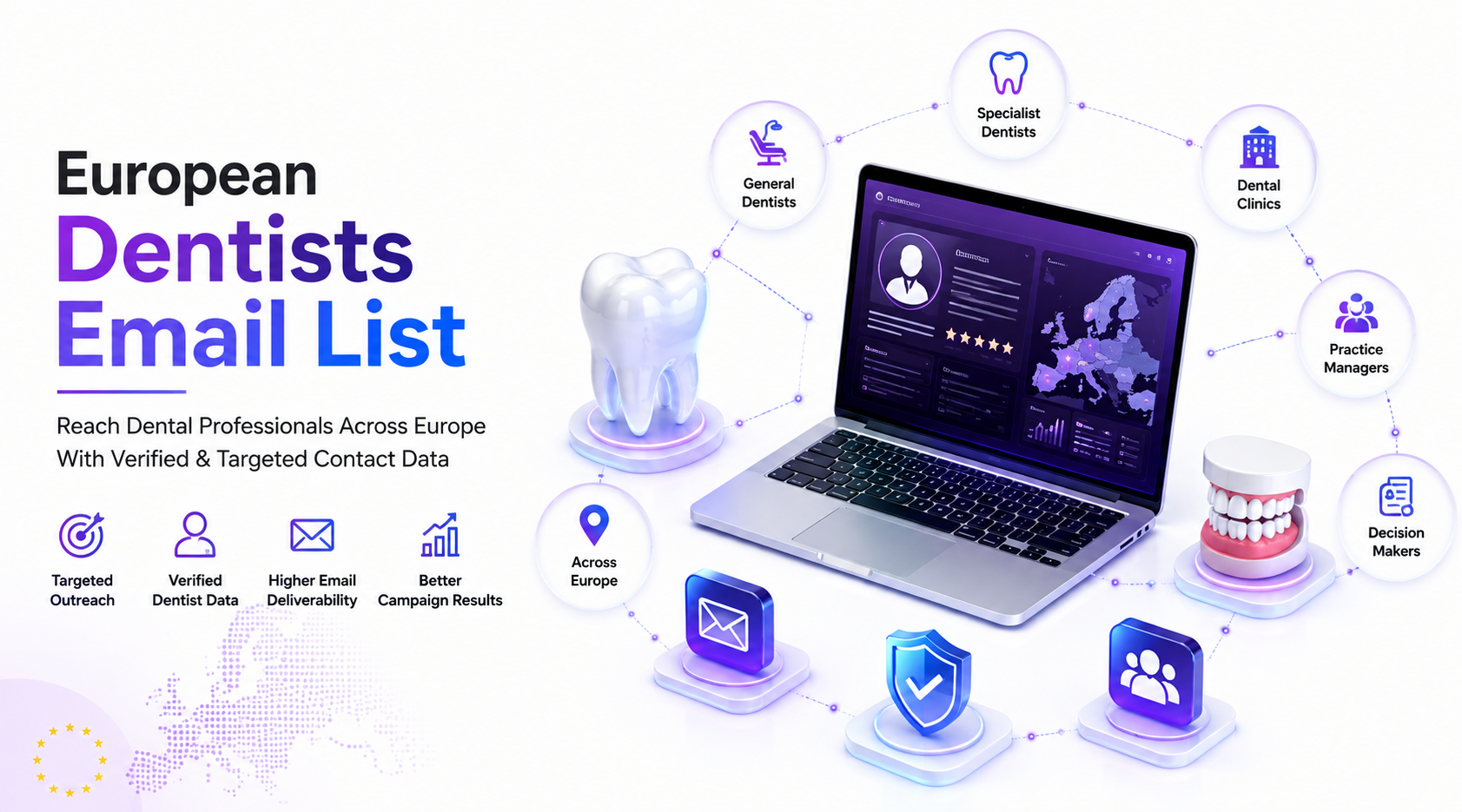
A targeted European Dentists Email List can help businesses build more focused outreach campaigns by identifying relevant dental professionals based on criteria such as country, specialty, job role, practice type, and geographic location.
Europe represents a substantial and diverse dental professional market. Eurostat reported more than 363,000 dentists across the EU countries covered by its 2022 data, while more recent European healthcare data continues to show significant variation in dentist availability between countries.
Instead of relying on broad healthcare audiences or spending hours researching individual practices, marketers can use targeted dental data to create more relevant prospecting and lead-generation campaigns.
A European Dentists Email List is a targeted database of dental professionals, dental practices, and relevant decision-makers located across European markets. Depending on the available data and targeting requirements, businesses may use such a database to identify dentists, dental specialists, practice owners, clinic managers, and other professionals involved in dental purchasing or business decisions.
A well-segmented European dental database may help businesses target:
The goal is not simply to reach more contacts. The goal is to build a more relevant audience for a specific product, service, market, or campaign.
Europe offers access to a large and geographically diverse dental professional ecosystem. However, the opportunity is not the same in every country.
The number of dentists, the availability of specialists, healthcare structures, patient demand, and practice models vary significantly across European markets. OECD data, for example, shows substantial differences in dentist availability and dental consultations between European countries.
This makes broad, one-size-fits-all marketing less effective.
A company targeting dental professionals in Germany may have different ideal customer profiles, market conditions, and outreach requirements than a company targeting dentists in the Netherlands, France, Spain, Italy, or the Nordic countries.
The Council of European Dentists also represents a broad network of national dental associations and chambers across European countries, reflecting the fragmented and country-specific nature of the European dental profession.
For marketers, this creates an important opportunity:
The more precisely you define your target dental audience, the more relevant your outreach can become.
The most effective dental marketing campaigns do not treat every dental professional as the same type of prospect.
Different products and services are relevant to different roles.
General dentists may be relevant targets for companies offering:
General practitioners may also be influential purchasing decision-makers, particularly within independent dental practices.
A targeted European dentists database may also be segmented by specialty where relevant information is available.
Potential specialty segments include:
Specialty targeting can help businesses create more relevant campaigns.
For example, an orthodontic technology provider may achieve stronger relevance by targeting orthodontists rather than sending the same campaign to a broad dental audience.
Research also shows meaningful differences in the proportion and distribution of dental specialists across European countries, reinforcing the value of country- and specialty-level segmentation.
Dental clinic owners can be particularly valuable for companies selling products or services that require business-level purchasing decisions.
Examples include:
Practice managers may influence or manage operational decisions involving:
Targeting practice managers can help companies reach professionals responsible for evaluating operational solutions.
Larger dental clinics, dental groups, and healthcare organizations may have purchasing professionals responsible for supplier relationships and procurement decisions.
For businesses selling high-value products or recurring supplies, identifying these decision-makers may be more effective than targeting a general professional audience.
A dental email database can contain different data fields depending on the provider, source, country, and available verification processes.
A targeted European dentists list may include information such as:
The most valuable data is not necessarily the database with the largest number of fields.
The most valuable database is one that helps you identify the right audience for your specific campaign.
For example, a dental software company entering Germany may prioritize:
A dental equipment supplier may prioritize different information, such as clinic type, purchasing responsibilities, and specialty.
Effective European dental marketing starts with audience segmentation.
Rather than creating one large campaign for every dentist in Europe, businesses can build smaller and more relevant audience segments.
Country-level targeting can help businesses focus their campaigns on priority markets.
Depending on data availability, campaigns may target dental professionals in markets such as:
Each market should be approached based on its own commercial opportunity, customer profile, and applicable marketing requirements.
Specialty-based segmentation can improve message relevance.
For example:
Orthodontic technology → Orthodontists
Dental implant solutions → Oral surgeons, prosthodontists, implant-focused professionals
Children’s healthcare solutions → Pediatric dentists
Endodontic equipment → Endodontists
When the audience and offer are closely aligned, marketers can create more personalized campaigns.
Different professionals participate in different types of decisions.
Potential job-role targeting may include:
Practice-level segmentation may include:
Businesses can also build more localized campaigns based on:
This can be particularly useful for events, regional sales teams, local service providers, and market-entry campaigns.
A targeted dental audience can support multiple B2B marketing and sales strategies.
Manufacturers and suppliers can identify dental professionals who may be relevant to products such as:
Instead of promoting the same product to every healthcare professional, companies can build campaigns around relevant dental roles and specialties.
Technology companies can target dental professionals and practice decision-makers for solutions such as:
Practice owners and managers may be particularly relevant audiences for these campaigns.
Suppliers of recurring products can use segmentation to identify relevant practice types and professional audiences.
Potential campaigns may focus on:
Education providers can reach professionals based on specialty, geographic location, or professional interests.
Potential use cases include:
Event organizers can create more targeted promotional campaigns by identifying dental professionals within specific countries or cities.
Recruitment companies and professional service providers may use dental audience data to identify relevant businesses and professionals.
Access CampaignLake's Industry-Specific Email Database
1. Reach a More Relevant Audience
A targeted list can help businesses focus their campaigns on professionals who are more closely aligned with their offer.
Relevance should be the priority over raw contact volume.
2. Expand Into Multiple European Markets
Businesses planning international expansion can create country-specific audiences rather than treating Europe as a single market.
3. Improve Campaign Personalization
Segmentation can help marketers adapt campaigns based on:
4. Support Account-Based Marketing
Companies selling high-value B2B solutions can identify specific types of dental practices and decision-makers.
This can support more focused account-based marketing and sales strategies.
5. Reduce Manual Prospecting Time
Manual prospect research across multiple countries can be time-consuming.
A structured database can help marketing and sales teams organize potential audiences more efficiently.
6. Support Multi-Channel Outreach
Dental audience data may support a broader marketing strategy that includes:
Businesses can build dental prospect lists manually, but the approach may become difficult to scale when targeting multiple countries.
| Factor | Targeted Dental Database | Manual Prospecting |
|---|---|---|
| Time required | Potentially faster | Often time-intensive |
| Geographic targeting | Can support multi-market campaigns | Requires country-by-country research |
| Audience segmentation | May offer structured filters | Must be performed manually |
| Scalability | Suitable for larger campaigns | More difficult to scale |
| Data organization | Structured | Requires additional research and management |
| Campaign preparation | Potentially faster | Can require significant effort |
Manual prospecting may still be useful for highly targeted strategic accounts.
However, businesses targeting hundreds or thousands of potential dental prospects across multiple markets may benefit from structured audience data.
Not all dental databases are equally useful.
Before choosing a provider, businesses should evaluate how the data aligns with their marketing goals.
Ask whether the audience can be segmented by criteria such as:
Ask how the provider manages:
Europe is not one uniform market.
Make sure the provider can support the specific countries relevant to your campaign.
The ability to target a dentist by specialty may be more valuable than simply having a large list of generic dental contacts.
The best solution for many B2B campaigns is not a pre-built list.
It is a customized audience built around the campaign’s ideal customer profile.
usinesses using professional contact data in Europe should carefully consider applicable privacy, data protection, and electronic marketing requirements.
The European Commission notes that direct marketing may, in some circumstances, be based on legitimate interests, but organizations must assess the specific circumstances and ensure that the rights and freedoms of individuals are appropriately considered. The Commission also states that organizations acquiring third-party contact databases must be able to demonstrate that the data was obtained in compliance with GDPR and may be used for the intended advertising purposes.
Individuals also have the right to object to the processing of their personal data for direct marketing purposes, and organizations must respect such objections.
In addition, email marketing may be subject to national laws and electronic communications rules that vary by country.
Businesses should therefore:
This article provides general information and is not legal advice.
CampaignLake helps businesses build targeted audiences of relevant professionals and decision-makers for B2B marketing and sales campaigns.
Rather than relying on a broad, generic healthcare audience, businesses can define the type of dental professionals they want to reach.
Create an audience based on available criteria such as:
Depending on campaign requirements and available data, businesses can focus on professionals such as:
Businesses entering new European markets can develop country-specific audiences for more focused campaigns.
A structured dental audience can help marketing and sales teams spend less time organizing prospect information and more time developing relevant campaigns.
If your business is looking to reach dental professionals across Europe, a customized audience can help you focus on the countries, specialties, and decision-maker profiles most relevant to your campaign.
Step 1: Define Your Target Markets
Identify the countries and regions where you want to generate demand.
For example:
Start with the markets most relevant to your commercial strategy.
Step 2: Define Your Ideal Dental Audience
Decide who is most likely to influence or make a purchasing decision.
This could include:
Step 3: Choose Relevant Segmentation Criteria
Define the filters that matter for your campaign.
Potential criteria include:
Step 4: Build a Customized Audience
Create an audience that matches your ideal customer profile rather than purchasing an unnecessarily broad database.
Step 5: Develop Relevant Campaign Messaging
Your messaging should reflect the needs of the specific audience.
A practice owner, orthodontist, and procurement manager may all respond to different value propositions.
Look for relevant targeting capabilities, geographic coverage, data quality processes, update practices, transparency, and the ability to create customized audience segments.
The European dental market presents significant opportunities for companies offering relevant products, services, technology, and professional solutions.
However, reaching the right audience requires more than sending the same campaign to every healthcare professional.
A targeted approach can help businesses focus on:
By combining accurate audience targeting with relevant messaging and responsible marketing practices, businesses can build more focused campaigns designed to support lead generation and market expansion.
Ready to Reach More Decision-Makers?
Access verified business decision-maker data worldwide. Filter, download and build targeted outreach lists in minutes—without manual scraping or guesswork.

Ben Williams is a leading voice in B2B email marketing and data-driven lead generation. Known for his strategic mindset and deep understanding of high-performance email lists, Ben helps businesses cut through the noise and connect with their ideal audience. With a background rooted in growth marketing and sales enablement, he transforms raw data into revenue-generating campaigns that consistently deliver results. His work empowers organizations to streamline prospecting, boost conversions, and maximize ROI. Beyond the inbox, Ben stays at the forefront of emerging trends in data intelligence and B2B engagement, always seeking innovative ways to elevate campaign performance.