A Students Email List, also called a student mailing list or student email database, is a permission-based collection of verified student contacts paired with academic and demographic data. B2B sales teams, education providers, recruiters, SaaS companies, publishers, and training providers use it to reach a defined student audience with course offers, campus tools, financial products, or career resources.
What Is a Students Email List?
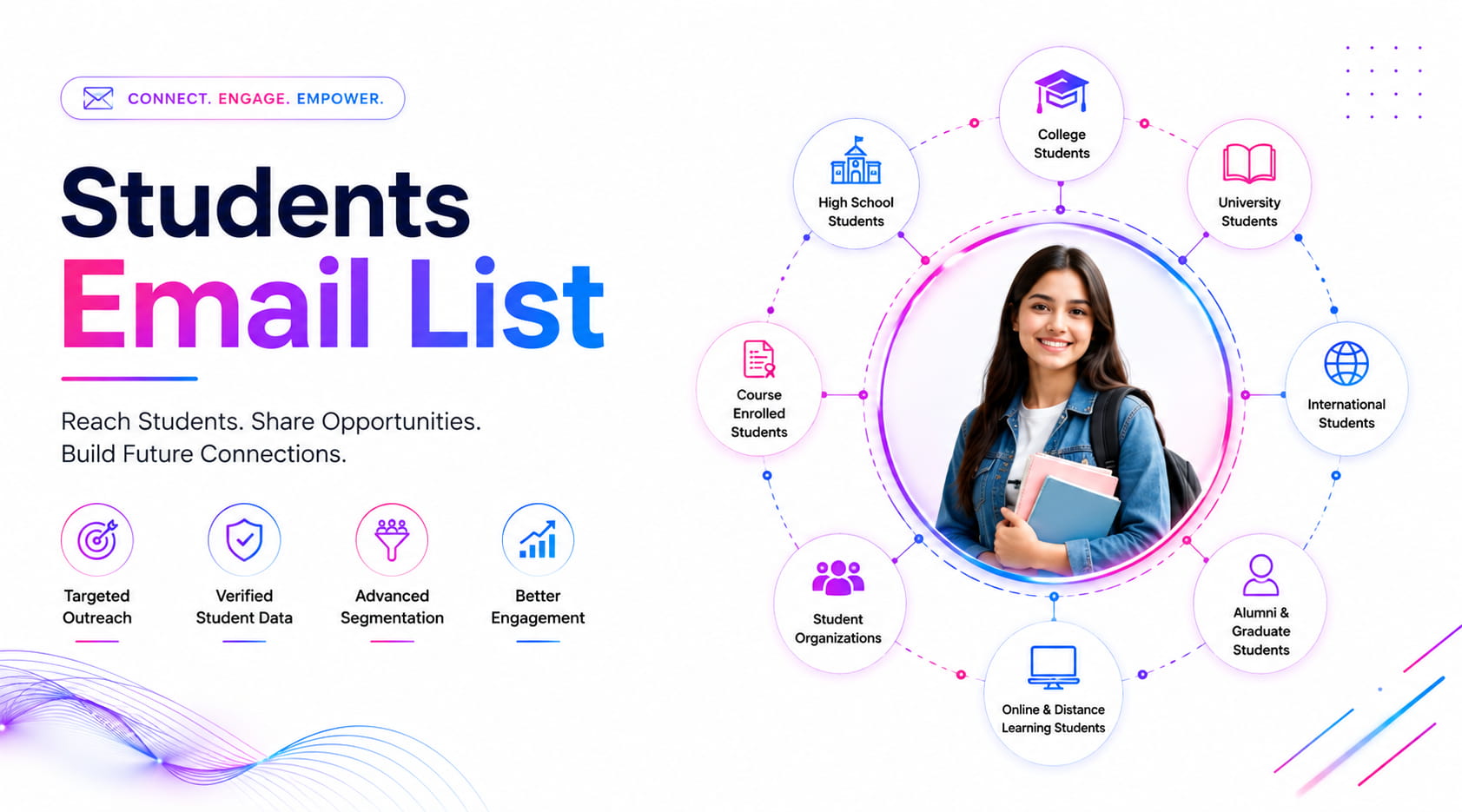
A Students Email List is a structured contact database of students, segmented by academic level, institution, field of study, and location, built specifically for outreach rather than general advertising. Each record pairs a working student email address with profile data that lets marketers filter for relevance before sending. It is not a scraped or generic consumer list; it is compiled and maintained for permissioned B2B and B2C marketing to a defined student audience.
Depending on the provider, a Students Email List may include:
- Undergraduate students.
- Graduate and postgraduate students.
- High school seniors preparing for college.
- Community college and vocational or trade school students.
- International students studying in the United States.
A useful list goes beyond the email address itself. Relevant fields typically include academic level, major, institution name and type, graduation year, location, and a last-verified date, all covered in more detail in the data table below.
Why Does a Students Email List Matter for B2B Outreach?
A Students Email List gives B2B sales teams, demand generation marketers, and admissions teams at colleges and universities a direct channel into a specific stage of the education path, rather than a broad and unfiltered audience. The result is fewer wasted sends and outreach that matches what a defined group of students is actually looking for at that time.
Use cases vary by industry:
- Higher education and admissions teams: promote degree programs, transfer pathways, or continuing-education courses to prospective and current students at colleges and universities.
- Recruitment agencies and staffing firms: build internship and graduate-hiring pipelines ahead of the campus recruiting season.
- SaaS companies: offer student pricing tiers, campus ambassador programs, or productivity and study tools to a verified student base.
- Publishers: reach students with textbook, research-database, or journal-access offers tied to specific majors or course levels.
- Training providers and certification bodies: promote bootcamps, professional certifications, or exam-prep courses to students nearing graduation.
- Event organizers: fill seats at career fairs, campus recruiting events, and student-focused conferences or webinars.
- Financial services and technology companies: introduce student banking, budgeting tools, or discounted hardware and software where the offer is clearly relevant and sent in line with applicable marketing rules for that audience.
Across all of these, the value comes from precision, not volume. A Students Email List built on real segmentation lets B2B sales teams and marketers speak to a specific stage, major, or institution type instead of running one generic message to everyone with a school email address.
What Data Fields Belong in a Student Email Database?
A usable Student Email Database pairs a verified email address with academic and demographic context, so marketers can filter, personalize, and suppress records instead of sending one message to an undifferentiated list. The fields below are the ones that most directly affect targeting and deliverability.
| Data Field | Segmentation Use | Marketing Application |
|---|---|---|
| Verified student email address | Confirms the record is reachable | The deliverable itself; every other field supports this one |
| Academic level (high school senior, undergraduate, graduate) | Filters by stage of the education path | Matches program offers, admissions content, or career resources to the right stage |
| Major or field of study | Filters by discipline | Targets software, textbook, certification, or career offers relevant to that field |
| Institution name and type (public, private, community college) | Filters by institution segment | Supports institution-specific partnerships or regional campaigns |
| Expected graduation year | Filters by proximity to graduation | Times recruiting, career-services, or certification outreach correctly |
| Location or campus | Filters by region | Supports local events, regional recruiting, and timezone-aware sending |
| Enrollment status (full-time or part-time) | Filters by engagement pattern | Separates traditional students from working adult learners with different needs |
| Email domain type (institutional vs. personal) | Filters by verification confidence | Signals whether an address is issued by the school or self-reported |
| Last verified date | Filters out stale records | Sets confidence level before a send and flags records due for re-verification |
How Do You Build and Run a Students Email List Campaign?
Running an effective campaign starts before you buy or use any data: define who you are trying to reach, then work outward through segmentation, verification, contact selection, campaign build, and measurement. The six steps below cover that full cycle.
1. Identify Your Target Student Audience
Start with the academic level, major, institution type, and location that match your offer. A recruiting agency filling technical internships needs a different audience than a publisher promoting a general-education textbook, and defining that difference up front prevents wasted sends later.
2. Define Your Segments
Break the target audience into smaller groups based on the fields that actually change your message, such as graduation year, program type, or campus. Each segment should have a distinct offer or angle; if two segments would receive the same email, they are not really separate segments.
3. Evaluate Data Quality Before You Buy
Ask any Students Email List provider how addresses are verified, how recently the list was refreshed, and what happens to records that fail re-verification. A provider who cannot answer these questions clearly is a risk to your sending reputation.
4. Select the Relevant Contacts
Scope the list to the exact segments defined in step two rather than purchasing a broad, unfiltered student database. A smaller, well-matched list consistently outperforms a larger, generic one on opens, clicks, and conversions.
5. Build the Campaign
Write subject lines and content around the specific segment, not a general student stereotype. Include a clear call to action, a working unsubscribe link, and sender identification that meets applicable email marketing requirements for the regions your contacts are in.
6. Measure Results and Refine
Track opens, clicks, conversions, bounces, and unsubscribes by segment, not just in aggregate. Use those results to decide which segments to prioritize on the next send and which fields in your data actually predict engagement.
What Are Best Practices for Student Email Marketing?
The best-performing student email campaigns treat the list as a maintained asset rather than a one-time purchase. The practices below cover the areas that most affect deliverability and response.
- Segment before you send. Group by academic level, major, and institution type so each message matches a specific reader instead of a generic student persona.
- Personalize beyond the first name. Reference the reader’s field of study, graduation timeline, or campus where the data supports it.
- Verify on a schedule, not once. Student email addresses change often around enrollment, transfer, and graduation, so plan for periodic re-verification rather than a single check at purchase.
- Keep every send relevant to the segment. An offer that fits graduating seniors will not land the same way with first-year students; match the message to the stage.
- Protect deliverability. Authenticate your sending domain, monitor bounce and complaint rates, and remove unengaged addresses before they damage your sender reputation.
- Test before scaling. Run subject lines, send times, and offers against a smaller sample before committing a full segment to one version.
- Measure by segment, not just campaign. Aggregate open and click rates can hide which specific groups are actually responding and which are dragging the average down.
What Common Mistakes Should You Avoid?
Most underperforming student email campaigns trace back to a handful of avoidable issues rather than the channel itself. Watch for these before you launch.
- Poor targeting. Sending one message to an entire student database instead of a defined segment produces low relevance and low response.
- Outdated records. Student contact information changes quickly around enrollment and graduation, so an unverified list ages out faster than most B2B data.
- Irrelevant messaging. An offer built for graduate students rarely lands with high school seniors, and generic messaging reads as spam to both.
- Weak segmentation. Splitting a list by only one field, such as location, ignores the academic-level and major data that usually predicts engagement better.
- Over-emailing. Sending too frequently to the same segment increases unsubscribes and complaint rates, which damages deliverability for future campaigns.
- Ignoring applicable privacy and marketing requirements. Commercial email to any audience in the United States must meet CAN-SPAM requirements, and lists that include contacts in Canada or the European Union bring CASL or GDPR consent standards into the campaign as well. Institution-held education records are also protected separately under FERPA, so marketers should confirm how a provider sourced its data rather than assuming a purchased list carries the same rules as public directory information.
Where Does CampaignLake Fit In?
CampaignLake builds targeted B2B contact databases, including a Students Email List segmented by academic level, major, institution, and location. It is built for teams that need a defined student audience rather than a generic education-sector list.
- Student records segmented by academic level, field of study, institution type, and location.
- Data verification and refresh cycles designed to reduce bounces and keep records current.
- Custom list builds scoped to a defined student audience rather than sold as one fixed bundle.
- Sample records available before purchase, so marketers can check fit and quality independently.
Use this as a starting point for research and comparison, and confirm verification methods and compliance practices directly with any provider, including CampaignLake, before committing a campaign budget.
Students Email List Key Takeaways
- A Students Email List is a permission-based database of verified student email addresses paired with academic and demographic data.
- B2B sales teams, education providers, recruiters, SaaS companies, publishers, and training providers each use it for different, specific outreach goals.
- Useful data fields go beyond the email address to include academic level, major, institution type, and graduation year.
- Segmentation, not list size, is what drives response and conversion in student email campaigns.
- Data quality depends on the verification method, refresh cycle, and how recently each record was confirmed.
- Common mistakes include poor targeting, outdated records, weak segmentation, and ignoring applicable privacy and marketing requirements.
- CampaignLake and similar providers can supply segmented student data, but compliance and campaign quality remain the marketer’s responsibility.
Students Email List Checklist
- Define the exact student segment (academic level, major, institution type, location) your offer is built for.
- Ask any provider how records are verified and how recently the list was refreshed.
- Confirm your sending practices meet CAN-SPAM, and CASL or GDPR where applicable, before the first send.
- Set up tracking by segment so you can measure opens, clicks, and conversions separately, not just in aggregate.
- Schedule periodic re-verification rather than treating the list as a one-time purchase.
Frequently Asked Questions
A Students Email List is a database of verified student email addresses paired with academic and demographic data such as major, institution, and graduation year. It is built for B2B and B2C marketers who need to reach a defined student audience rather than the general public or the broader education workforce.
B2B sales teams, demand generation marketers, education providers, recruitment agencies, SaaS companies, publishers, and training providers use Students Email Lists. Each group targets a different segment, such as graduating seniors for recruiting or specific majors for software and textbook offers, rather than treating all students as one audience.
Commercial email to students in the United States falls under the CAN-SPAM Act, which requires honest sender information, a working opt-out, and prompt processing of unsubscribe requests. If your list includes contacts in Canada or the European Union, CASL or GDPR consent requirements apply as well, and those are stricter than CAN-SPAM.
FERPA governs how schools and colleges disclose education records they hold directly; it does not automatically apply to a third-party marketing database compiled outside the institution. Marketers should still ask any provider how contact data was sourced, since data drawn from a school’s directory information carries different disclosure rules than independently compiled contact data.
Start with academic level and field of study, then layer in institution type, graduation timeline, and location. Effective segments each have a distinct offer or message; if two segments would receive an identical email, combine them or refine your criteria until each group needs different content.
An Education Email List typically targets education-sector professionals such as administrators, teachers, and school staff. A Students Email List targets the students themselves, segmented by academic level, major, and institution, which makes it suited to recruiting, campus marketing, and student-facing offers rather than professional B2B outreach to educators.
Yes, but marketers should confirm which countries the list covers and apply the strictest applicable consent and marketing rules for that mix of contacts, since a list spanning the United States, Canada, and the European Union brings CAN-SPAM, CASL, and GDPR requirements into the same campaign.
Conclusion
A Students Email List works when it is treated as a segmented, verified asset rather than a shortcut to volume. Define the exact student audience your offer serves, confirm how the data behind any list is verified and refreshed, and build campaigns around segments rather than one message to everyone with a school email address. Marketers who do this consistently see better response from student audiences than those running broad, unfiltered sends, while staying inside the privacy and marketing rules that apply to this audience.